
Short answer: A cut-anywhere COB LED strip is a flexible linear light designed to be cut at much shorter and more frequent intervals than a conventional LED strip. Its COB light-emitting surface produces a continuous-looking line of light, while the flexible cutting layout makes it easier to fit shelves, cabinets, display cases, coves, counters, and other installations with non-standard dimensions. The correct result still depends on the complete system: the strip, mounting surface, aluminium profile, power supply, connectors, dimming method, and installation workmanship.
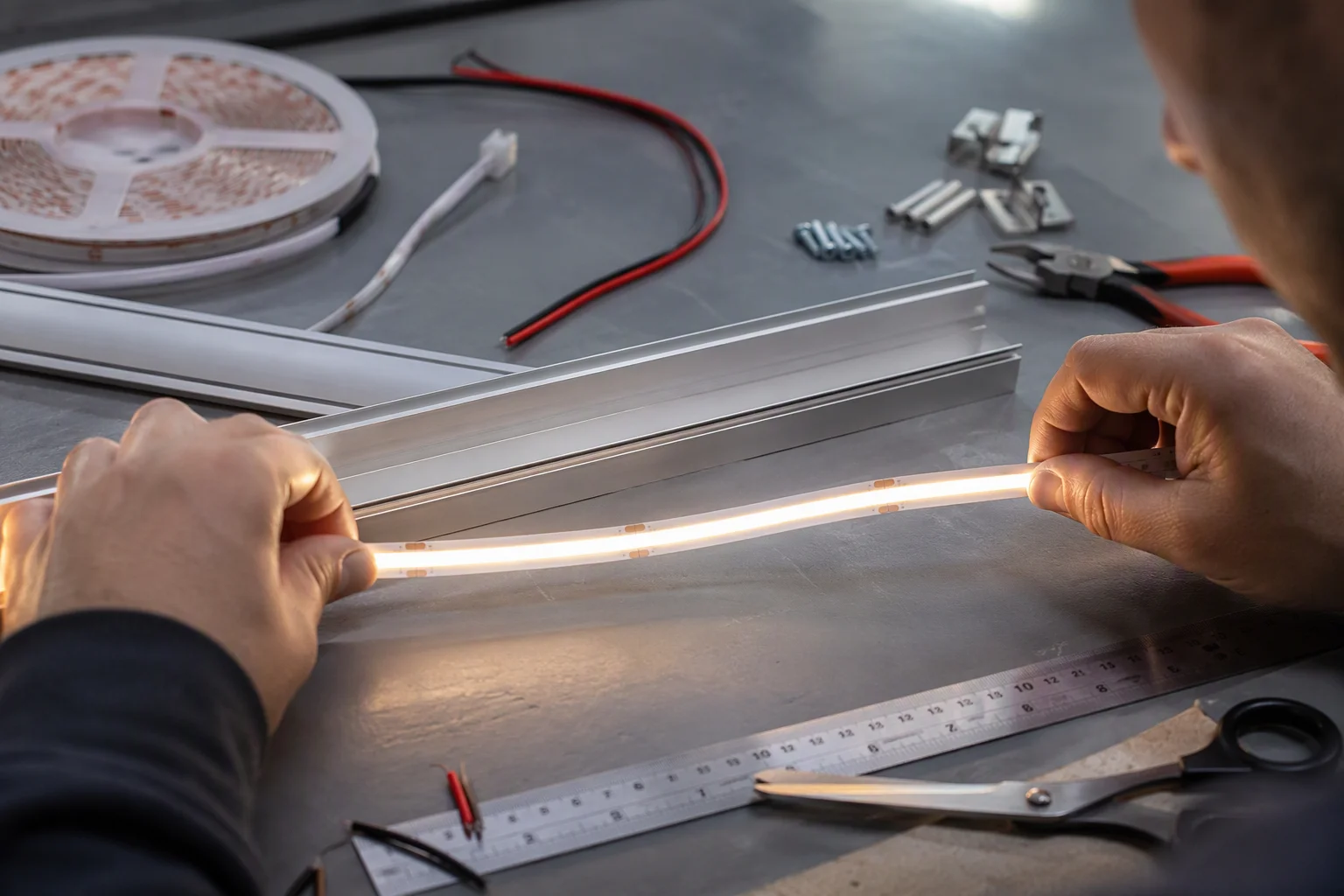
Preparing a cut-anywhere COB LED strip and profile before installation.
What Is a Cut-Anywhere COB LED Strip?
A cut-anywhere COB LED strip combines a chip-on-board light-emitting structure with a flexible circuit layout that allows the strip to be separated at closely spaced cut positions. Instead of designing every installation around one fixed cut interval, installers can measure the actual space first and then prepare a more accurate strip length.
The term “cut-anywhere” does not mean that the strip can be cut randomly through every electrical component. It means the product is engineered with a much more flexible cutting arrangement than a standard strip. The exact cutting rule depends on the product construction, voltage, circuit design, and manufacturer’s instructions. Before production or installation, confirm the approved cutting locations for the specific SKU.
How Does the COB Light-Emitting Surface Work?
COB LED strips place many LED chips directly on a circuit substrate and cover the emitting area with a continuous phosphor layer. When installed at the correct viewing distance, this creates a smoother linear appearance with fewer visible dark gaps than a strip using widely spaced individual LED packages.
The visual result is influenced by more than the COB structure alone. Profile depth, diffuser material, mounting angle, viewing distance, colour temperature, surface reflectance, and the distance between the strip and the illuminated surface all affect the final appearance.
COB structure: helps create a continuous-looking luminous line.
Flexible cutting layout: helps match custom lengths and irregular dimensions.
Aluminium profile: supports mechanical protection and heat transfer.
Diffuser: softens the output and helps control glare.
Correct power design: keeps the strip operating consistently across the installation.
What Makes Cut-Anywhere COB Strips Different from Standard LED Strips?
Project consideration | Cut-anywhere COB LED strip | Standard LED strip |
|---|---|---|
Length flexibility | Designed for closer cutting intervals and more precise fitting | Usually follows a more fixed cutting interval |
Light appearance | Continuous-looking line when installed correctly | May show individual LED points, especially without a diffuser |
Best use cases | Custom furniture, cabinets, displays, coves, counters, and irregular spaces | Longer runs with predictable dimensions and accessible cutting points |
Installation planning | Measure the finished space first, then cut to the required length | Plan the layout around the available circuit sections |
Connection method | Use connectors or soldering methods approved for the specific construction | Use the connection system specified for the product |
Thermal planning | Still requires an appropriate mounting surface and, where needed, aluminium profile | Also requires heat management according to power density and environment |
Where Can You Use a Cut-Anywhere COB LED Strip?
The strongest advantage appears where the available installation length is determined by finished furniture, millwork, display structures, or architectural details rather than by a standard product length. The following applications are especially suitable.
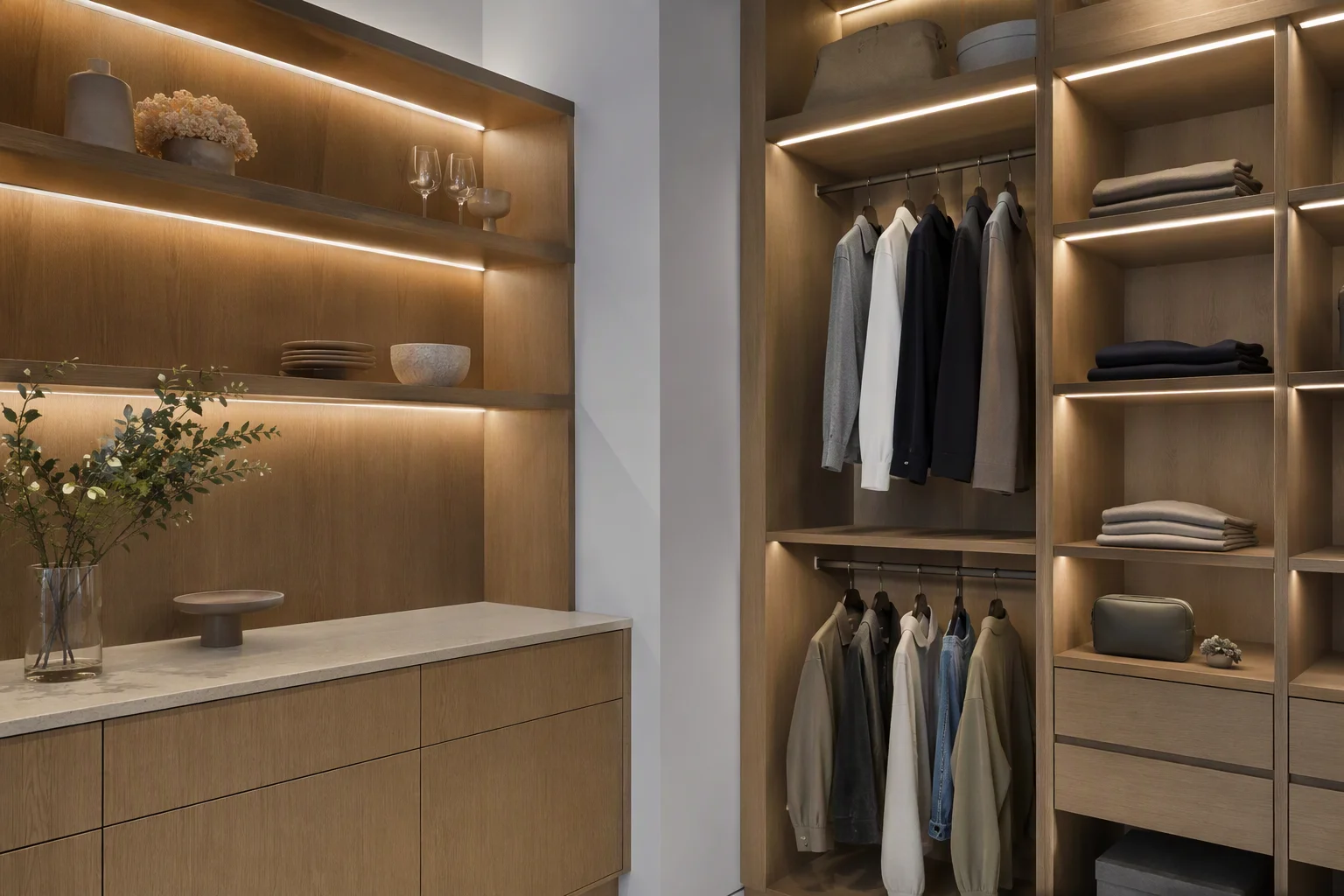
Custom cabinet and wardrobe sections benefit from precise strip lengths.
1. Custom Kitchen Cabinets and Shelving
Kitchen cabinets often contain different shelf lengths, side panels, corner units, and sections interrupted by hinges or appliances. A cut-anywhere COB strip can be prepared to fit each individual section more accurately, helping the installer maintain a consistent line of light across a complete cabinet run.
For under-cabinet work, confirm the viewing angle, diffuser position, cable exit, and cleaning requirements. A shallow aluminium profile can protect the strip and create a more finished edge, while a recessed profile can hide the light source more effectively.
2. Wardrobes and Dressing Areas
Wardrobes frequently combine vertical sides, horizontal shelves, hanging sections, drawers, and narrow compartments. Cut-anywhere flexibility is useful when each compartment has a different internal width or when the strip must stop before hinges, runners, or ventilation gaps.
For a reliable result, leave enough space for wiring and service access. Do not place the strip where clothing, sliding doors, or metal hardware can repeatedly rub against the emitting surface or cable connection.
3. Retail Display Shelves
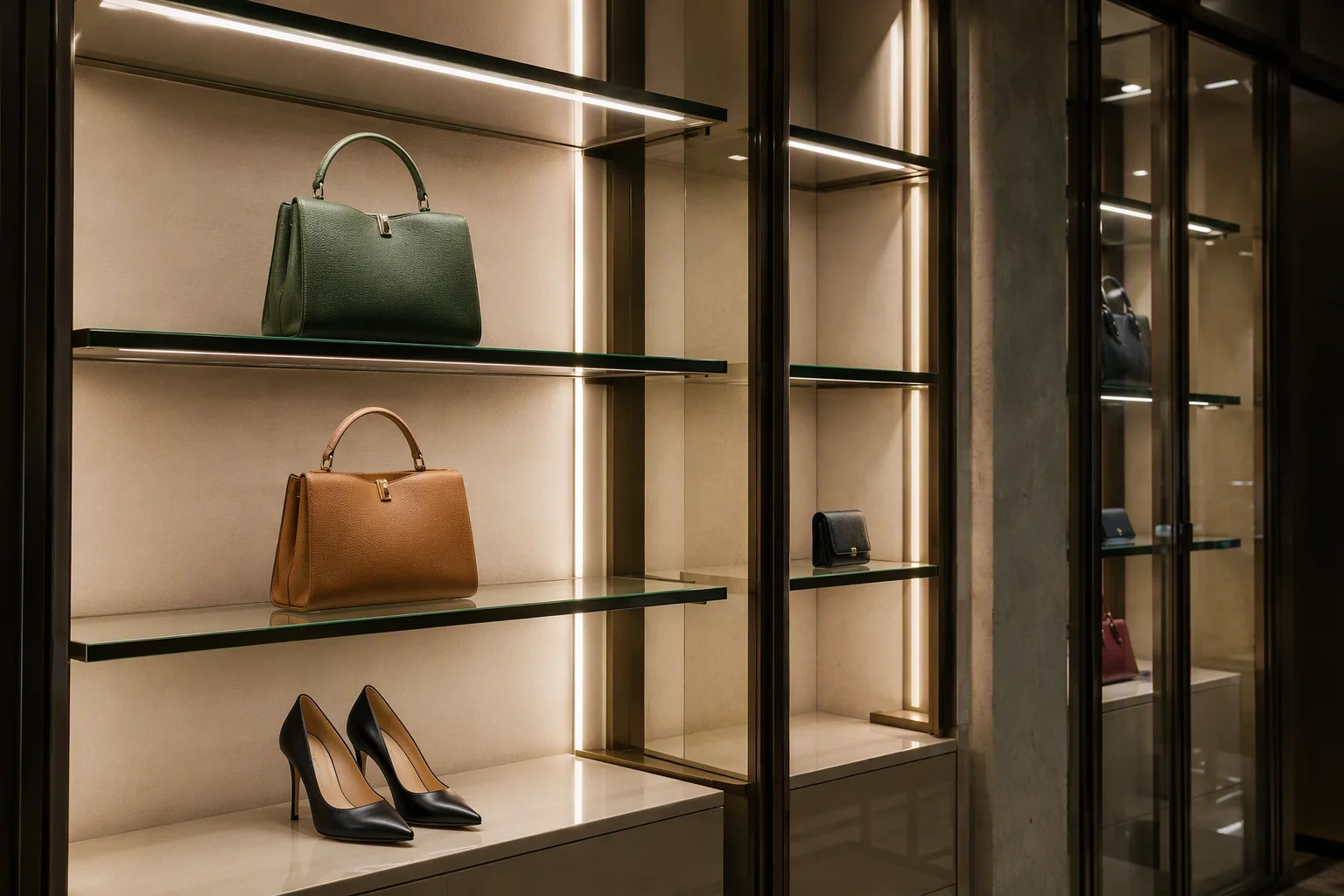
Retail shelves use short custom sections to keep the light line aligned with each display zone.
Retail fixtures are commonly built in modular sections with different shelf widths and display depths. A continuous-looking COB strip can provide a clean product-facing line without exposing obvious LED dots through glass or on glossy packaging.
Before installation, test the light on the actual product materials. White packaging, reflective glass, polished metal, and coloured surfaces can make the same colour temperature appear very different.
4. Display Cases and Museum Cabinets
Display cases require careful control of glare, heat, reflections, and access for maintenance. The flexible cutting layout helps the installer fit narrow horizontal shelves, vertical edges, or short top sections without forcing a longer strip into an unsuitable position.
The strip should not be treated as the only design decision. The case ventilation, diffuser, mounting channel, wiring route, and access panel should be reviewed together, especially where sensitive objects or heat-sensitive materials are displayed.
5. Hotel Headboards and Hospitality Millwork
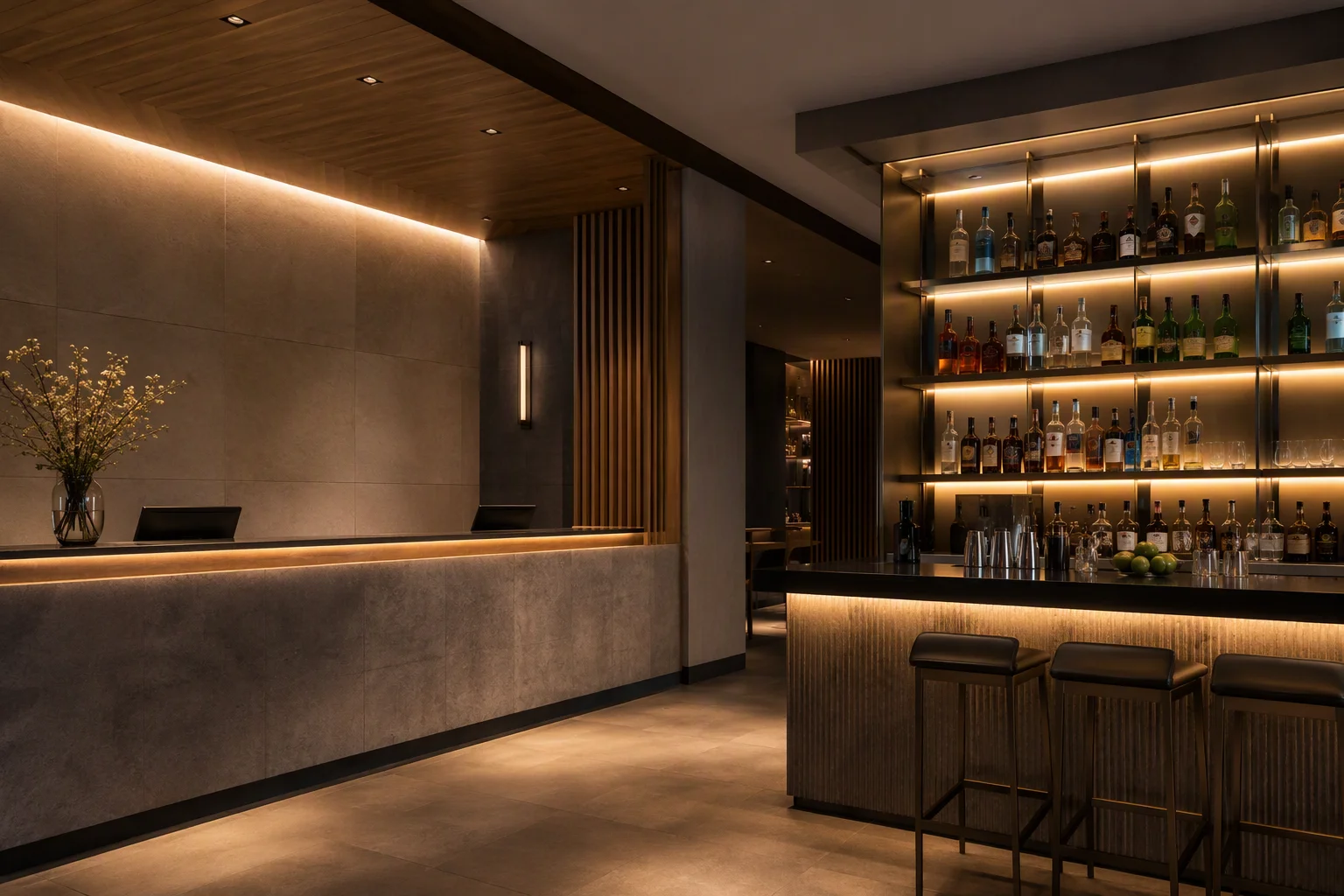
Hospitality projects often combine several short illuminated sections in one interior.
Hotels use linear lighting in headboards, wardrobes, reception counters, bedside structures, mirrors, and decorative wall details. These elements often contain multiple short sections, which makes precise length preparation valuable during installation.
For hospitality projects, specify the colour temperature and dimming behaviour with a physical mock-up. The same fixture may need to support a calm ambient setting, a brighter cleaning setting, and a consistent appearance across many guest rooms.
6. Restaurant Counters and Back Bars
Restaurants and bars often use concealed lighting beneath counters, inside shelving, under bottle displays, and around menu or service areas. A cut-anywhere COB strip can simplify installation where cabinet widths and shelf lengths vary from one section to another.
Food-service environments require practical attention to cleaning, moisture exposure, grease, heat, and cable protection. Select the complete installation system according to the environment; the strip body alone does not define the protection level of the finished installation.
7. Office Storage and Workplace Furniture
Modern offices use illuminated shelving, storage walls, reception furniture, collaboration tables, and display niches. These installations may combine different materials and dimensions within one project, so the ability to prepare shorter custom sections can reduce visible overshoot and unnecessary cable loops.
Where the light is used for task support, evaluate the actual illuminance and glare separately. A decorative COB strip can create an attractive linear effect, but it is not automatically a complete task-lighting system.
8. Architectural Coves and Recessed Linear Details
Architectural lighting details rarely have one universal length. Ceiling coves, wall recesses, joinery slots, niches, and feature panels may contain short returns, corners, or interruptions. Cut-anywhere COB strips can help designers create a more controlled layout around these details.
Longer architectural runs still require voltage-drop planning, feed-point decisions, profile continuity, and access for replacement. Closely spaced cutting positions improve fitting flexibility, but they do not remove the need for electrical and thermal planning.
9. Reception Desks and Branded Environments
Reception desks, information counters, and branded interior structures often combine curved or segmented surfaces with short illuminated details. A cut-anywhere strip can be prepared around panels, logos, shelves, and trim lines without leaving large unlit gaps at the ends.
For curved applications, confirm the minimum bending direction and bending radius of the specific product. Do not force the strip around a curve that exceeds its mechanical limits, and avoid twisting the circuit while trying to align the light-emitting surface.
10. Signage and Directional Details
Cut-anywhere COB strips can be used for concealed illumination inside shallow sign boxes, directional features, letter backs, and branded architectural details when the product’s dimensions and thermal conditions are suitable.
Signage is highly sensitive to shadowing and uneven spacing. Build a small sample section before committing to a full run, and check the result with the final diffuser, face material, mounting distance, and viewing angle.
How Should You Measure Before Cutting?
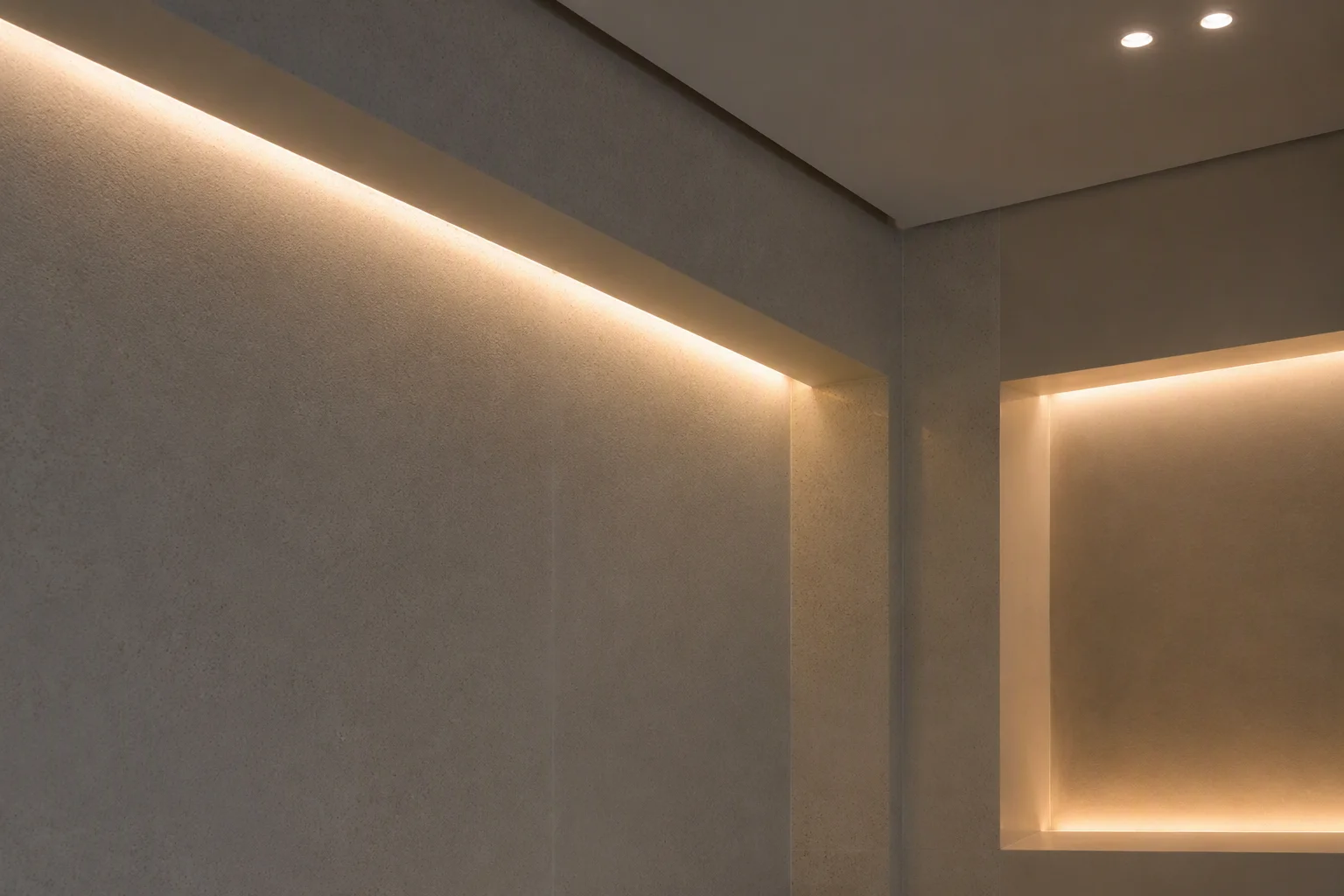
Architectural coves and niches require accurate measurement around returns and interruptions.
Accurate measurement is the first step in getting value from a cut-anywhere product. Measure the finished installation rather than estimating from a drawing alone, because trim thickness, corner details, cable exits, and mounting hardware can change the usable length.
Measure the illuminated path from the actual start point to the actual end point.
Mark corners, interruptions, hinges, connectors, and cable exit locations.
Confirm whether the strip will sit inside a profile, behind a diffuser, or directly on a surface.
Allow space for the end connection and strain relief.
Check the manufacturer’s approved cutting locations for the selected SKU.
Record each section separately instead of treating a multi-section installation as one length.
How Do You Cut a COB LED Strip Correctly?
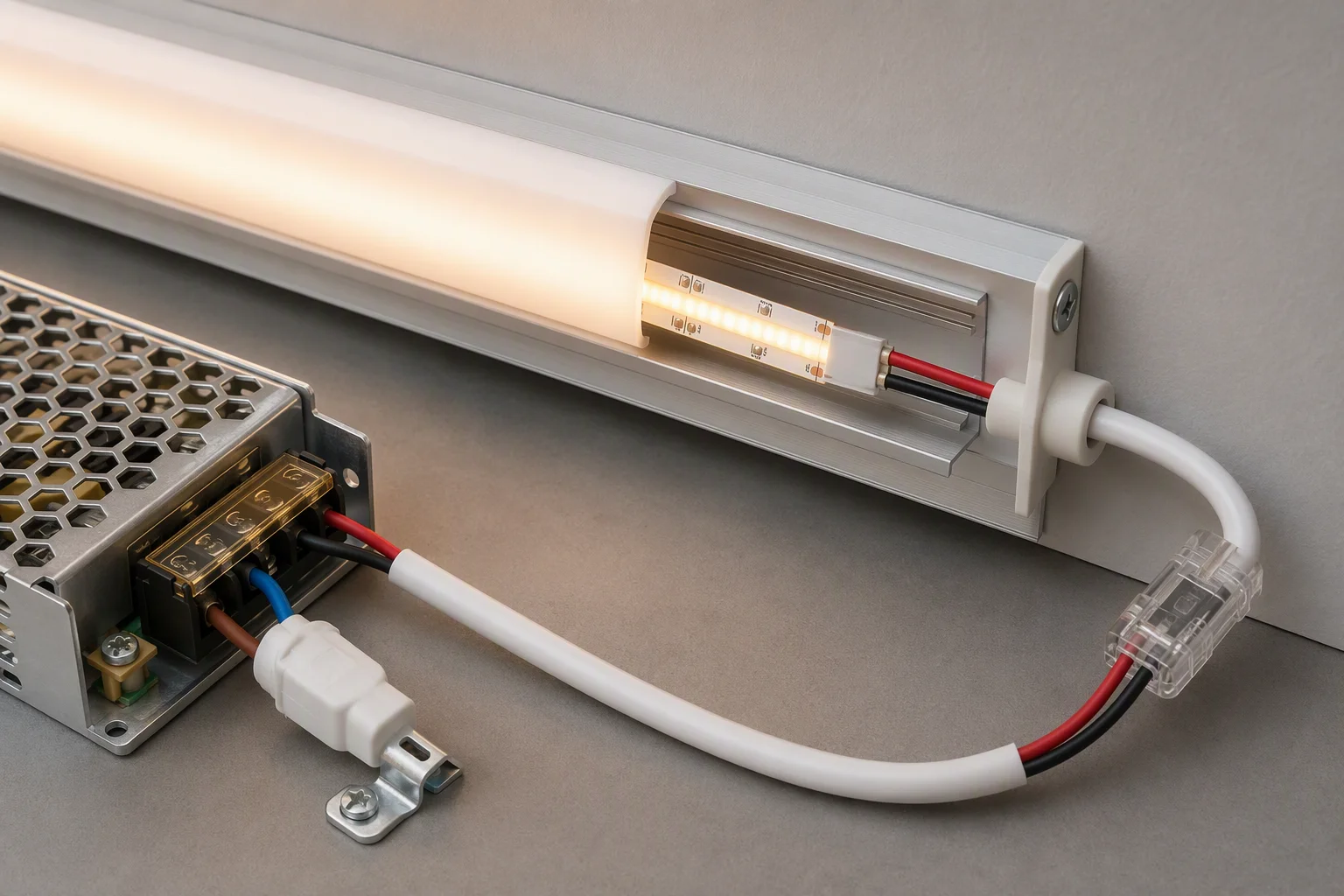
A finished profile should protect the strip, connection, cable exit, and diffuser as one system.
Turn off the power before cutting. Use a clean, sharp cutting tool and follow the visible or documented cut marks supplied for the product. Do not assume that every point between two marks is electrically safe. Cutting through a chip, resistor, conductive path, or sealed section can make the section unusable or create a connection risk.
After cutting, inspect the end for exposed copper, damaged encapsulation, loose phosphor, or a distorted circuit board. Use an approved connector, soldering method, end cap, or seal according to the product construction and the installation environment.
How Should You Plan Power and Voltage Drop?
Cutting flexibility does not remove the electrical limits of the product. The power supply must be selected from the actual installed length and product power specification, with suitable allowance for operating margin and the project’s control method.
For longer runs, assess voltage drop and brightness consistency before installation. Depending on the product and layout, the solution may include shorter sections, multiple feed points, parallel wiring, or a different power distribution arrangement. Never solve a voltage-drop problem by simply increasing the power supply rating without checking the strip, wiring, controller, and thermal conditions.
Confirm the strip voltage before selecting the power supply.
Calculate the total connected load from the actual cut lengths.
Check conductor size and cable length for each feed section.
Plan the power injection points before the profile is closed.
Test the first and last sections under normal operating conditions.
Why Is Heat Management Still Important?
COB technology improves the visual appearance of a linear light, but it does not make heat irrelevant. LED performance and service life are affected by operating temperature, power density, ambient conditions, enclosure design, and the quality of the mounting path.
For commercial and furniture projects, mount the strip on a clean, stable surface. Use an aluminium profile when the product power, installation length, enclosure, or ambient temperature makes additional heat transfer appropriate. Do not cover a high-output strip with materials that trap heat unless the complete design has been tested.
How Do You Create a Clean, Continuous Light Line?
A continuous-looking COB surface is only one part of the optical design. To avoid visible breaks and uneven sections:
Keep the strip straight and fully seated in the profile.
Maintain consistent distance from the illuminated surface.
Use the same product, colour temperature, and batch where possible across one visual line.
Align cut sections in the same orientation.
Hide connectors and cable exits outside the primary viewing zone.
Use a diffuser when the project requires glare control or a softer appearance.
Test corners and end points before closing the installation.
Which Controls and Dimmers Can You Use?
The control method must match the electrical design of the selected strip and power supply. Depending on the product, a project may use an on/off switch, a compatible dimmer, a controller, or a building-control interface. Confirm compatibility before purchasing rather than assuming that every dimmer works with every low-voltage LED system.
For projects with multiple zones, label each circuit and define the intended behaviour of each zone. A commissioning test should include startup, dimming range, minimum-level stability, power recovery, and simultaneous operation of all connected sections.
What Should Be Included in a Cut-Anywhere COB LED Strip RFQ?
RFQ item | What to provide |
|---|---|
Application | Cabinet, display, hospitality, architectural, signage, or another defined use |
Section lengths | Individual measured lengths, including short sections and returns |
Voltage | Required system voltage and power-distribution arrangement |
Light colour | Colour temperature or colour type, with a sample approval requirement where needed |
Installation environment | Indoor, damp, enclosed, exposed, cleanable, or other relevant condition |
Profile | Surface, recessed, corner, suspended, or another mounting format |
Control | On/off, dimming, zoning, sensor, or building-control requirement |
Accessories | Power supplies, connectors, end caps, cables, diffusers, and mounting hardware |
Quality checks | Sample length, visual uniformity, connection test, and packaging requirements |
What Mistakes Should Installers Avoid?
Cutting without checking the SKU instructions
“Cut-anywhere” is a product capability, not permission to cut through any visible point. Confirm the actual cut marks and connection method for the exact model.
Installing directly on a poor mounting surface
Dust, oil, uneven surfaces, and weak adhesive contact can cause the strip to lift, move, or lose thermal contact. Clean and prepare the surface before installation.
Ignoring short-section connections
Short sections still need secure electrical and mechanical connections. Protect the connection from strain, movement, moisture, and accidental contact with metal edges.
Using the wrong profile or diffuser
A profile that is too shallow, too narrow, or poorly matched to the viewing angle can create hotspots, glare, or heat accumulation.
Closing the installation before testing
Test every section before sealing the profile, installing the diffuser, or closing the furniture panel. Early testing makes it easier to correct polarity, wiring, alignment, and brightness problems.
Installation Checklist for Cut-Anywhere COB Projects
Confirm the exact strip SKU and approved cutting rule.
Measure every illuminated section on the finished structure.
Confirm voltage, colour, power density, and control compatibility.
Prepare the mounting surface and aluminium profile where required.
Cut only at approved positions with power disconnected.
Protect every end, connection, and cable exit.
Check polarity and test each section before final closure.
Verify brightness consistency from the normal viewing angle.
Leave a practical route for future inspection and replacement.
Record the final layout, power supply, wiring, and control zones for maintenance.
Frequently Asked Questions
Can a cut-anywhere COB LED strip really be cut at any point?
It can be cut at the closely spaced positions allowed by the specific product design. Always follow the manufacturer’s marked cutting locations and electrical instructions. The phrase describes increased cutting flexibility, not unrestricted cutting through every part of the strip.
Does cut-anywhere COB mean the strip has no dark areas?
No. The COB light-emitting surface can create a more continuous-looking line, but dark areas may still result from incorrect cutting, poor connections, inconsistent spacing, damaged sections, or unsuitable installation geometry.
Can I connect many short sections to one power supply?
Possibly, but the total load, cable arrangement, voltage drop, controller capacity, and heat conditions must be checked together. Multiple short sections should not be connected only because the power supply appears to have a sufficient nominal wattage.
Do cut-anywhere COB strips need an aluminium profile?
The answer depends on the product power, mounting surface, enclosure, environment, and required finish. An aluminium profile can improve heat transfer, protection, alignment, and diffusion, and is often valuable for commercial or built-in installations.
Are cut-anywhere COB strips suitable for curved furniture?
They can be suitable when the specific product supports the required bending direction and radius. Check the mechanical limits before installation and avoid twisting the strip or forcing it around a tight curve.
Can I use the same strip for decorative and task lighting?
Not automatically. A decorative strip may create an attractive glow but may not provide the illuminance, glare control, uniformity, or optical distribution required for task lighting. Evaluate the actual lighting function separately.
What is the most important information to provide when ordering?
Provide the application, individual section lengths, voltage, colour, power requirement, installation environment, profile, control method, connection needs, and sample approval requirements. These details help the supplier recommend a complete and serviceable system rather than only a strip roll.
How should I test a project before final installation?
Build a representative mock-up using the actual strip, profile, diffuser, power supply, control method, mounting surface, and finish materials. Check visual uniformity, colour appearance, heat, connections, dimming behaviour, and access for maintenance before repeating the solution across the project.