
What is COB LED Technology? The Definitive 2026 Technical Guide
COB (Chip-on-Board) LED technology has quietly become the backbone of modern linear lighting. Instead of mounting a handful of large SMD diodes side by side, COB strips pack hundreds of tiny LED chips directly onto a circuit board and seal them under one continuous phosphor layer. The result is a perfectly seamless, dot-free light line that is brighter, more efficient, easier to control and dramatically more durable than the LED strips most people have used for the past decade.
This guide is written for lighting professionals — specifiers, distributors, furniture manufacturers and electrical contractors — who need more than a sales pitch. Chapter by chapter we break down the flip-chip architecture, the physics behind the dot-free revolution, the thermal design that decides whether a strip lives 20,000 or 70,000 hours, and the exact specifications (CRI, SDCM, PCB copper weight) you should demand when sourcing quality COB strips for 2026 projects.
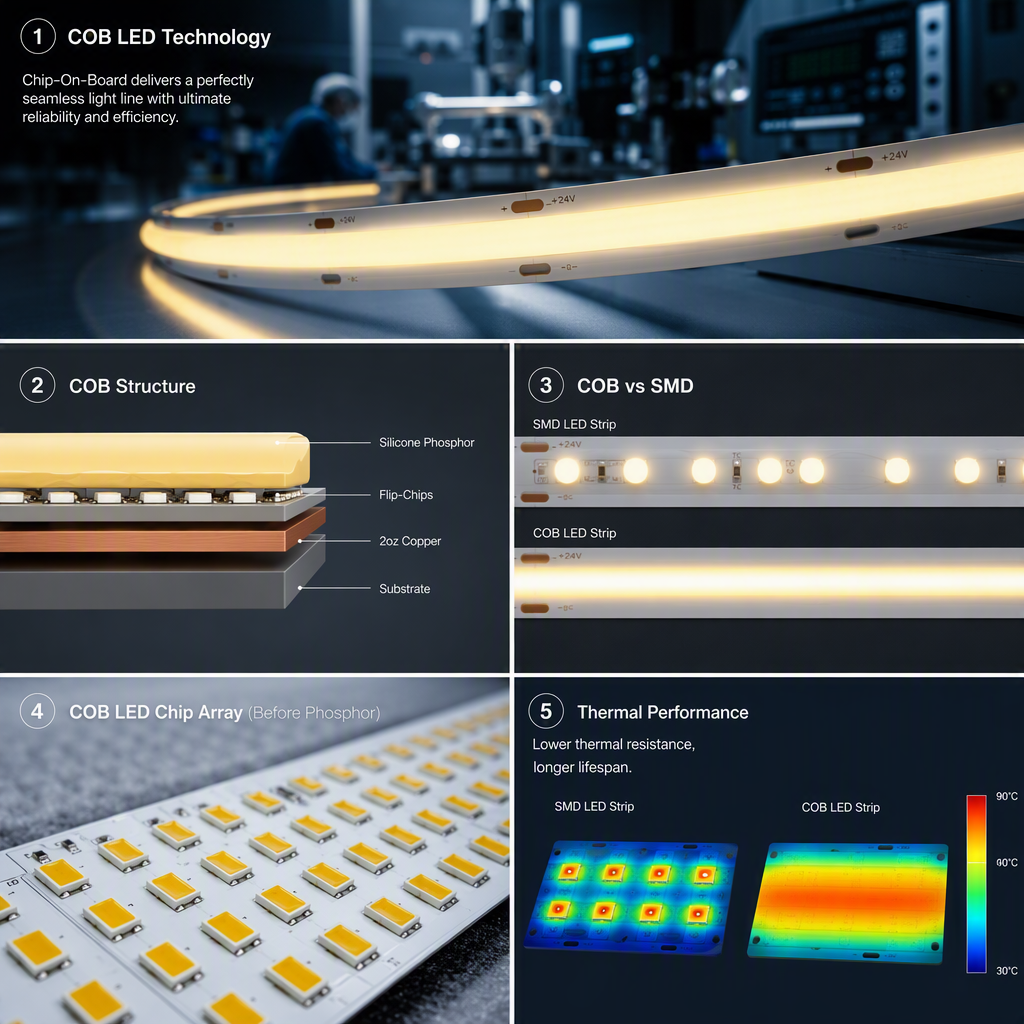
Chapter 1: Introduction to Flip-Chip Technology
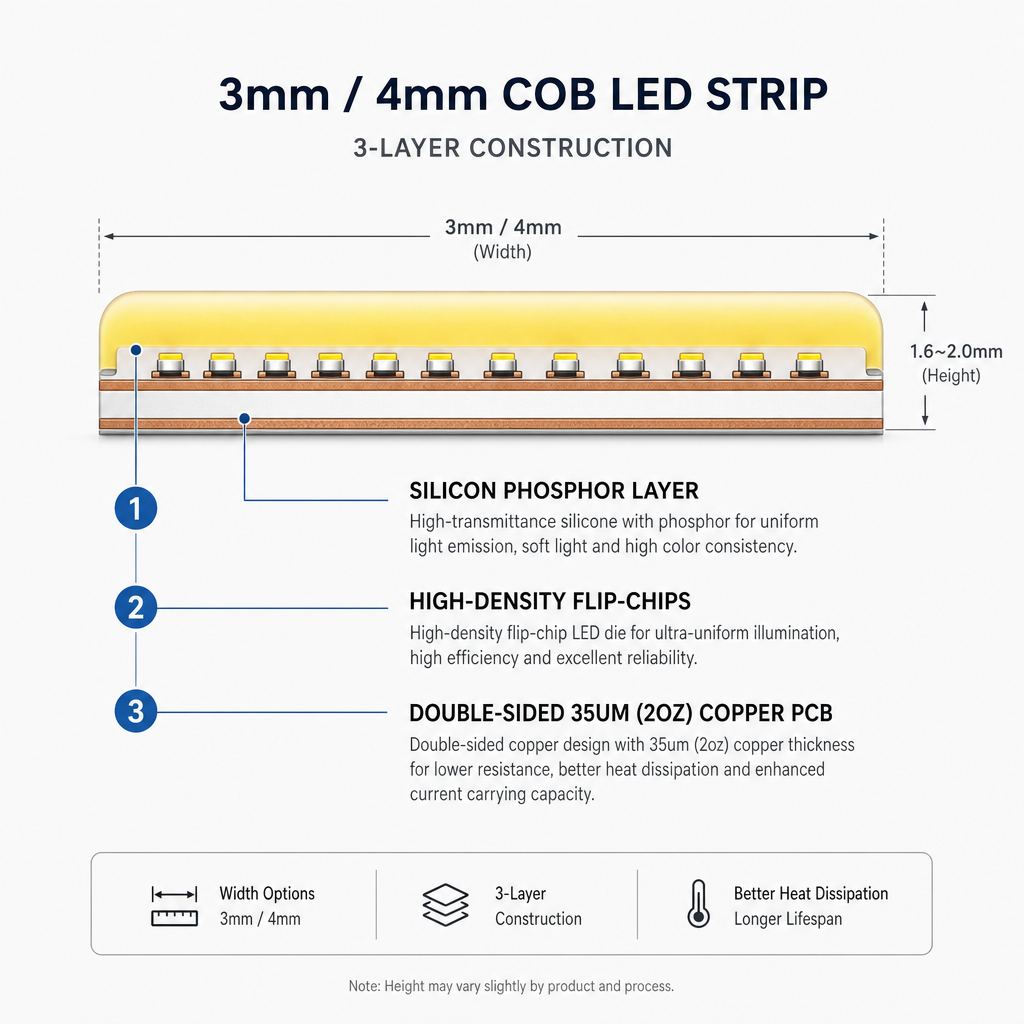
Flip-chip is the enabling technology inside every modern COB strip. In a conventional "wire-bonded" LED package, each die sits on a metal frame and is connected with tiny gold or copper wires, then wrapped in a reflector cup and lens. Those wires add resistance, block heat and create failure points. Flip-chip inverts the die: the light-emitting epitaxial layers face down toward a high-thermal-conductivity substrate, while the electrical contacts are re-routed to the bottom surface so the chip can be soldered directly to the PCB pads.
Why does this matter for your installation? Three engineering consequences:
- Lower thermal resistance. Heat travels straight from the junction through the substrate into the copper PCB, instead of detouring through bond wires. Lower junction temperature directly translates to longer L70 life and less colour drift.
- Higher packing density. Because there is no wire-bond loop and no reflector cup, chips can sit a few hundred microns apart — the geometric foundation of "no visible dots".
- No dead chips from wire fatigue. With no bond wires to fatigue under thermal cycling or flexing, flip-chip modules survive the repeated bending and on/off cycling of real furniture and architectural use.
When you see a COB strip advertised with a continuous yellow phosphor stripe, the architecture under that stripe is almost certainly a dense array of flip-chips on a metal-core or double-sided copper PCB. The quality of that stack — chip bin, phosphor, copper weight and solder process — is what separates a 50,000-hour professional strip from a hobby-grade one.
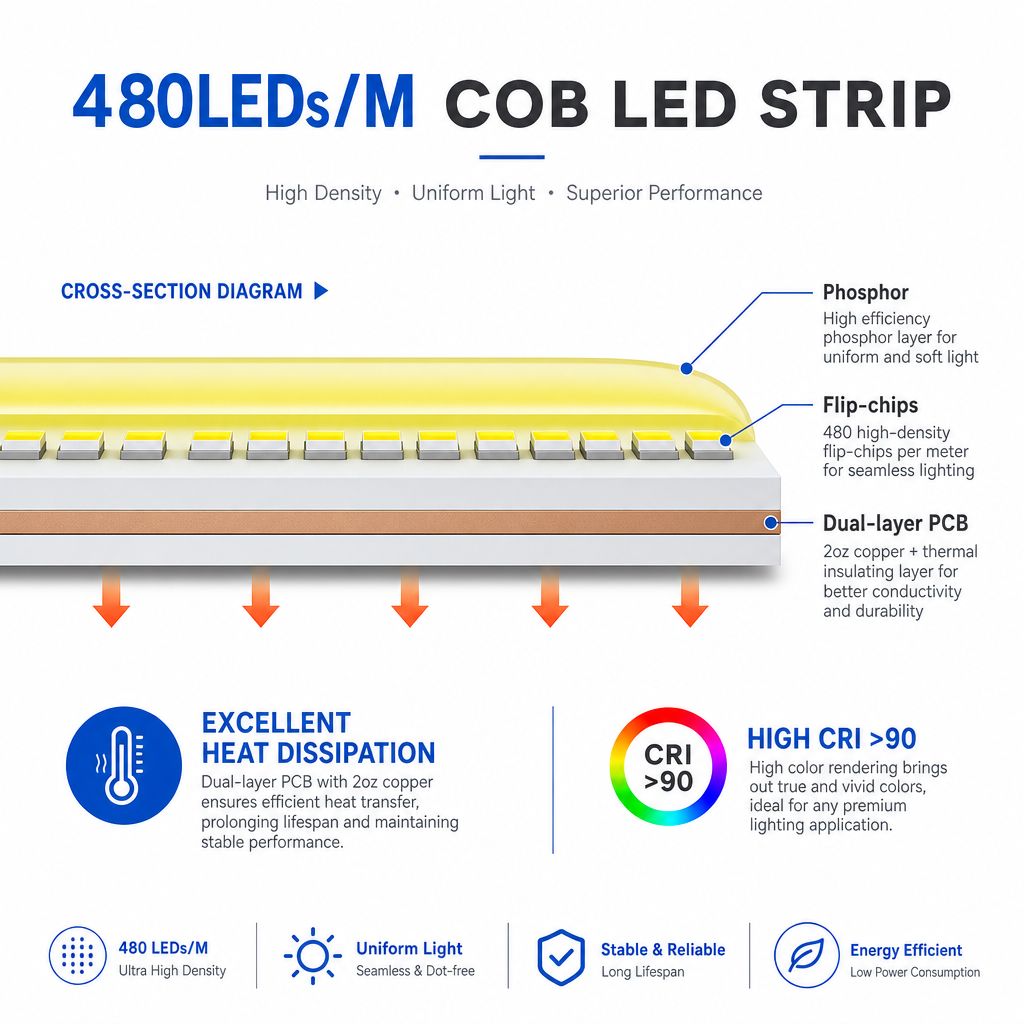
Chapter 2: COB vs. SMD — The Dot-Free Revolution
The single most visible difference between COB and SMD LED strips is the light itself. An SMD 5050 or 2835 strip emits from discrete point sources spaced 16–50mm apart, so at close viewing distance you see a string of dots, and between the diodes you see dark gaps, chips and resistors. A COB strip emits from one continuous luminous surface because hundreds of chips share a single co-extruded phosphor layer that converts and diffuses the light.
This is why "dot-free" has become the decisive specification in premium sectors:
- Architectural coves and reveals — a 1:1 continuous line with no bright spots on camera.
- Furniture and joinery — strips seen from 300mm or less in wardrobes, shelving and kickboards.
- Mirror and display lighting — any reflective surface amplifies individual SMD dots into visible artefacts.
- Photography and video — SMD point sources create banding and flicker artefacts on high-frame-rate cameras; a continuous phosphor line renders clean.
Density is the second chapter of the story. COB strips are rated in LEDs per metre — typically 320, 384, 480 or even 528 chips/m. Higher density means smoother light, wider beam overlap and lower maximum current per chip, which improves both uniformity and thermal behaviour. The trade-off is power and cost, so the "sweet spot" for most general lighting is 320–480 LEDs/m depending on the profile and lumen target.
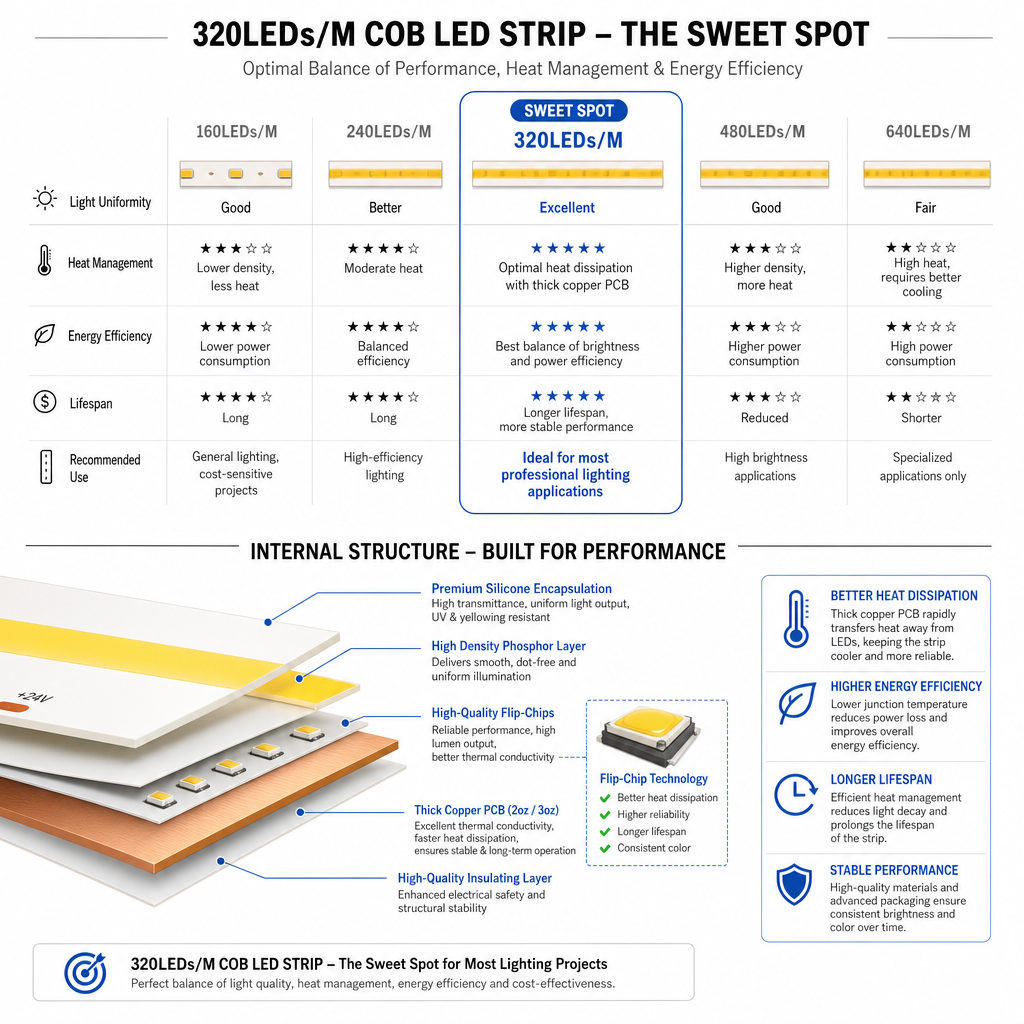
Chapter 3: Thermal Management & Durability Secrets
Heat is the number-one killer of LED strip. Every 10°C rise above the rated junction temperature roughly halves the LED's L70 lifetime, accelerates phosphor degradation (visible as yellowing and colour shift) and increases the risk of solder joint fatigue. Professional COB design attacks heat on four fronts simultaneously:
- Flip-chip junction-to-board path. The die's active layer sits close to the substrate, cutting the junction-to-PCB thermal resistance by up to 60% versus wire-bonded packages.
- Heavy copper PCB. A double-sided 2oz (70µm total copper) PCB acts as a lateral heat spreader, moving heat away from hot chips before it reaches the mounting surface. This is the same trick used in high-power LED modules and EV lighting.
- Phosphor engineering. The continuous silicone-phosphor layer both converts light and conducts heat sideways; quality phosphor resists thermal quenching that causes colour shift at high drive currents.
- Aluminium channel mounting. Even the best PCB needs somewhere to dump heat. Mounting COB strips in an aluminium profile with a thermal interface lowers operating temperature dramatically and is mandatory for enclosed coves.
Durability is not only about heat. A quality COB strip is fully silicone-encapsulated, which means the chips, solder joints and copper traces are sealed against moisture, dust and UV. The silicone itself should be UV-stabilised to prevent yellowing in daylight-exposed installations, and terminations should use IP-rated connectors rather than bare solder joints.
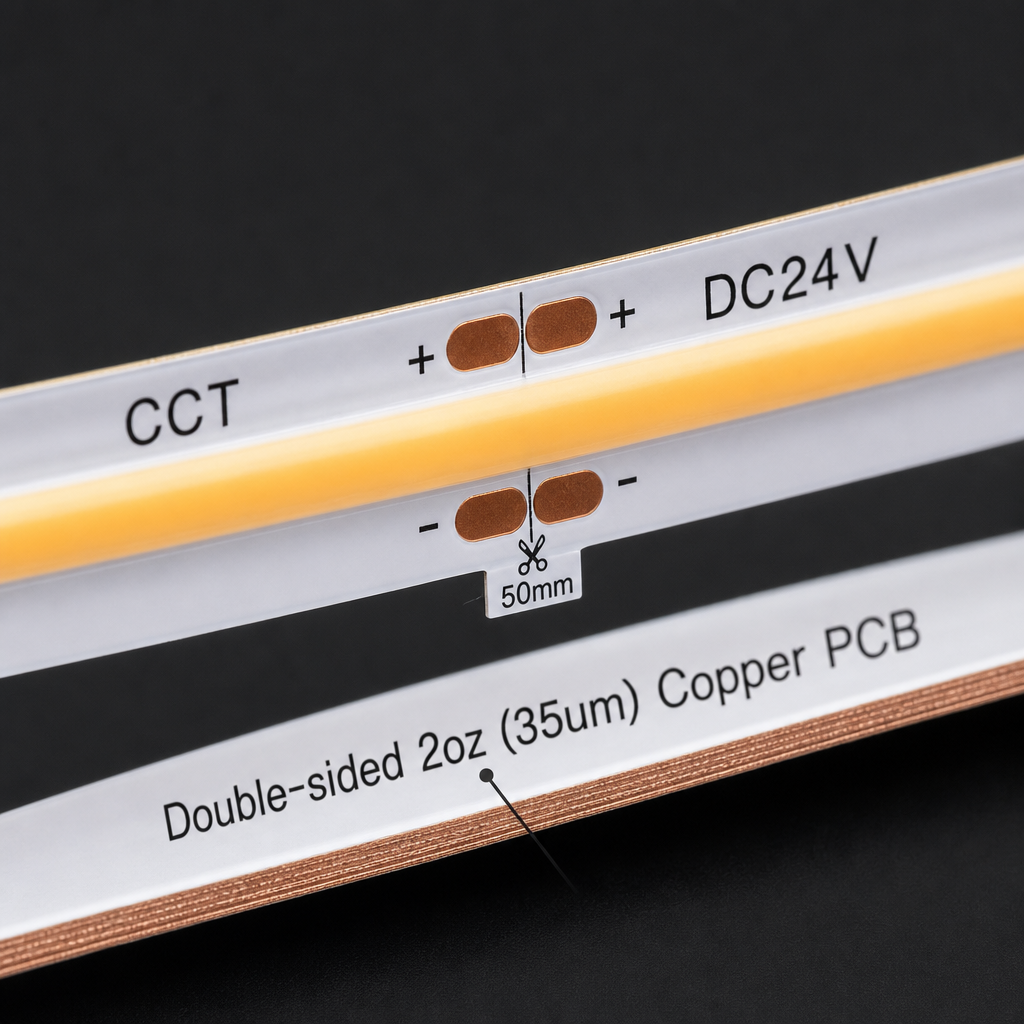
Chapter 4: How to Choose Quality COB Strips (CRI, SDCM, PCB Oz)
Not all "COB" is created equal. When comparing quotations for 2026 projects, demand three numbers that separate engineering-grade strips from commodity imports.
CRI (Colour Rendering Index) — aim for Ra ≥ 90, verify R9
CRI measures how faithfully colours appear under the light (Ra 100 = sunlight reference). For retail, hospitality, residential and any space where people, food or fabric matter, specify CRI ≥ 90 and ask for the R9 value (deep red) — a high-Ra strip with weak R9 will make reds look muddy. Professional ranges offer CRI 95 with full-spectrum phosphor blends.
SDCM (Colour Consistency) — keep it ≤ 3
SDCM (MacAdam ellipse) tells you how consistent the colour temperature is. A batch with 5-step SDCM can visibly differ between adjacent strips; premium suppliers bin their chips to ≤ 3 SDCM so multiple reels match in one installation. If you are lighting a wall of shelving from many reels, this number matters as much as CRI.
PCB Copper Weight — demand double-sided 2oz
Copper weight is measured in ounces per square foot. Cheap strips use 1oz or even 0.5oz single-sided copper, which creates voltage drop over long runs and poor heat spreading. Quality COB strips use double-sided 2oz (70µm) copper — lower electrical resistance, more even current distribution across hundreds of parallel chips, and a built-in heat spreader. For runs over 5 metres, also check the operating voltage: 24V systems halve the current and reduce voltage-drop problems.
Quick sourcing checklist
| Parameter | Professional-grade target |
|---|---|
| Chip architecture | Flip-chip COB, dense array, continuous phosphor |
| CRI | Ra ≥ 90 (95 for premium), R9 verified |
| SDCM / binning | ≤ 3-step MacAdam, matched reels |
| PCB copper | Double-sided 2oz (70µm) copper |
| Density | 320–528 LEDs/m depending on profile |
| Voltage | 24V DC preferred for runs > 5m |
| Encapsulation | UV-stabilised silicone, IP20/IP54/IP67 options |
| Documentation | IES/LM-80 data, CE/RoHS, batch test reports |
Chapter 5: 2026 Future Trends (Miniaturization & Integration)
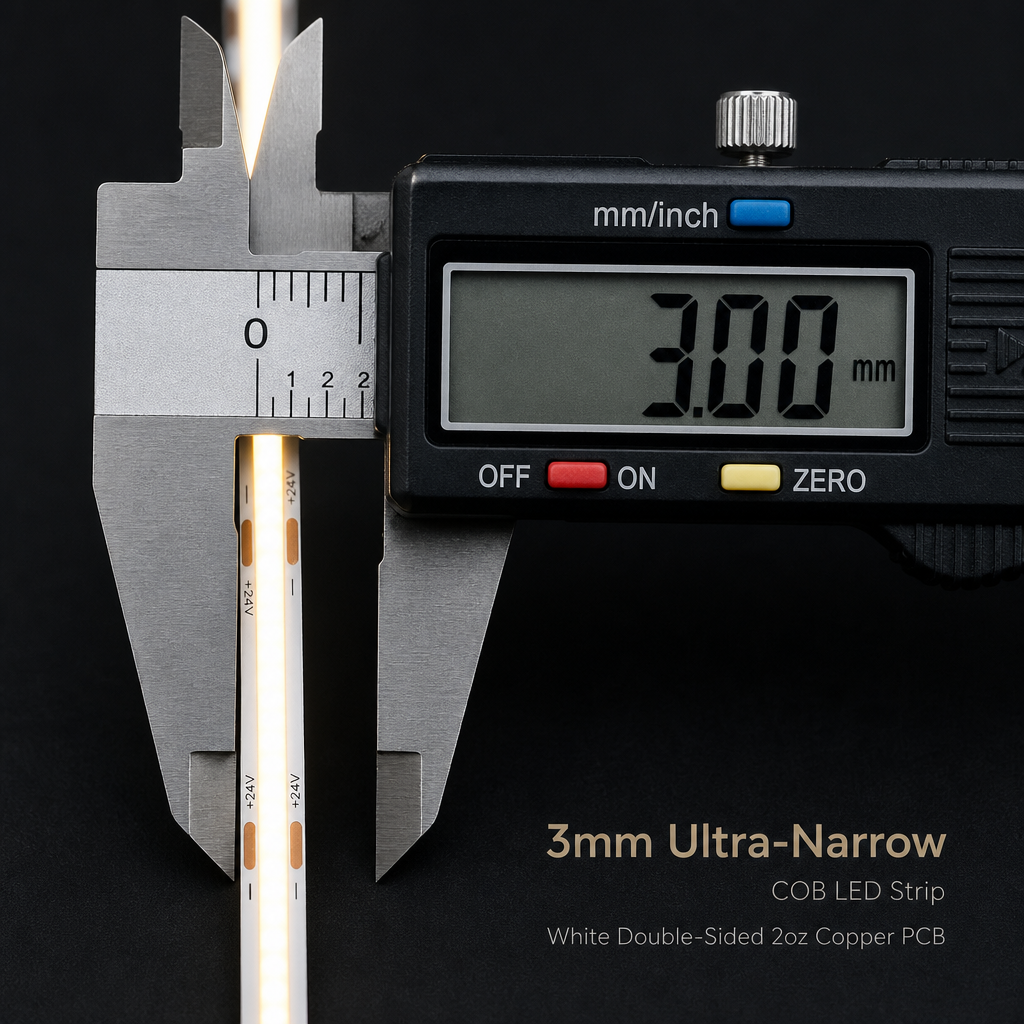
Two forces are reshaping linear lighting in 2026: miniaturisation and integration. On the miniaturisation side, the industry has moved from bulky 10–12mm neon profiles to 3mm and 4mm ultra-narrow COB strips that disappear into a 5mm routed slot while still delivering 300–400 lm/m. Denser flip-chip arrays and thinner phosphor layers are what make these profiles possible without sacrificing uniformity — a 3mm-wide strip with 480 chips/m still reads as one continuous line.
On the integration side, COB strips are becoming subsystems rather than components. Expect to see more: integrated constant-current drivers that eliminate voltage-drop engineering, sensor-ready strips with daylight and presence sensing, DALI-2 / Matter / Zigbee-native linear fixtures, and factory-terminated modular lengths with solderless connectors that cut installation time on site by half. Aluminium profiles, optics and drivers are increasingly co-designed with the strip rather than selected afterwards.
For specifiers this convergence means one decision now carries more weight than ever: choose a manufacturing partner with in-house COB assembly, optical design and thermal testing — because in 2026 the strip, the profile and the driver ship as one engineered system.
Technical FAQ: 10 Questions Lighting Professionals Ask About COB LED Strips
1. What exactly is COB LED technology?
COB (Chip-on-Board) is an LED packaging architecture in which many bare LED chips are mounted directly onto a circuit board and covered with a continuous phosphor layer, producing a single uniform light source instead of discrete point sources.
2. How is a COB strip different from a standard SMD strip?
SMD strips emit from individual packaged diodes visible as dots with dark gaps between them; COB strips emit from one continuous phosphor-coated surface, giving a seamless dot-free line with higher packing density per metre.
3. What does "dot-free" mean and why does it matter?
Dot-free means no individual light points are visible even at close viewing distance. It matters in furniture, coves, mirrors and camera-facing installations where SMD hotspots look unprofessional and create banding artefacts.
4. What is flip-chip technology in LED strips?
Flip-chip inverts the LED die so light-emitting layers face the substrate and electrical contacts solder directly to the PCB with no bond wires, improving heat path, density and reliability.
5. Is COB brighter than SMD at the same wattage?
Efficacy depends on chip bin and drive current, but COB generally delivers comparable or higher lumens per watt with far better uniformity, because more chip area is packed per metre and each chip runs at lower current.
6. What CRI should I specify for COB strips?
Specify Ra ≥ 90 as a minimum for retail and residential use and Ra ≥ 95 with verified R9 for colour-critical environments. Always request the test report rather than trusting the marketing sheet.
7. What is SDCM and why is it in the spec sheet?
SDCM (MacAdam ellipse step) quantifies colour-temperature consistency between strips. A 3-step or better binning ensures multiple reels appear identical in one installation; 5-step or looser risks visible mismatch on adjacent surfaces.
8. Why does PCB copper weight (oz) matter?
Copper weight drives electrical resistance and heat spreading. Double-sided 2oz copper reduces voltage drop along the strip, distributes current evenly across hundreds of parallel chips and lowers operating temperature, directly extending lifetime.
9. Can COB strips be cut and dimmed like regular LED strips?
Yes. Quality COB strips have printed cut marks at defined intervals (e.g. every 25–50mm) and are fully dimmable to 1% with PWM, 0/1-10V or TRIAC systems when paired with a compatible constant-voltage driver.
10. How long do COB LED strips last and what extends their life?
Professional COB strips are rated 50,000+ hours L70. Operating them below the rated temperature — via 2oz copper PCB, aluminium channel mounting and proper 24V feed sizing — is the single most effective way to push real-world life toward 70,000 hours.