Short answer: COB LED strips are most useful in commercial projects when the design needs a smooth, continuous line of light in a compact space. The ten most common application groups are retail displays, hospitality interiors, offices, restaurants and food-service spaces, furniture and cabinetry, wardrobes and millwork, display cases, architectural coves, reception and wayfinding details, and commercial signage or branded environments. The correct product still depends on the profile, emitting direction, voltage, power density, colour requirement, control method, installation environment, heat path, and service access.
Why Are COB LED Strips Used in Commercial Lighting?
Commercial lighting has to do more than make a space bright. It must guide attention, reveal materials, support tasks, fit into architectural details, remain maintainable, and perform consistently during long operating hours. A COB LED strip places a dense LED array on a flexible circuit and uses a diffusing layer to create a more continuous visual line than a conventional low-density strip. That makes it useful where individual LED points would distract from the product, joinery, sign, or architectural surface.
COB does not remove the need for lighting design. A continuous-looking line can still suffer from poor heat management, uneven voltage drop, visible connection points, unsuitable dimming, or the wrong colour choice. For a commercial specification, treat the LED strip, profile or channel, power supply, control equipment, wiring, mounting surface, and service plan as one system.
How Should a Commercial COB LED Strip Be Specified?
Before choosing a reel or sample, define the lighting task. Is the line illuminating a product, washing a wall, marking a circulation route, creating a ceiling cove, or providing a close-range task accent? The answer changes the required brightness, colour, beam direction, diffusion, mounting depth, and control strategy.
Profile and emitting direction: Confirm the physical profile and whether the light is intended to emit upward, sideways, or through a defined face.
Electrical design: Match the strip voltage and power demand with a correctly sized power supply, cable route, protection, and control method.
Thermal path: Provide a suitable mounting surface or aluminium profile where the product instructions require it. Do not treat adhesive tape alone as a universal heat-management solution.
Colour requirement: Select the colour temperature or colour system for the actual material, brand environment, food presentation, workplace, or architectural mood.
Maintenance: Keep power supplies, connectors, junctions, and replaceable sections accessible. A concealed light should not become an inaccessible service problem.
Environment: Confirm the complete installation method for dry, damp, dusty, or exposed areas. The strip body, end treatment, connections, power supply, and enclosure all matter.
Top 10 Commercial Applications for COB LED Strips
1. Retail shelves and product displays
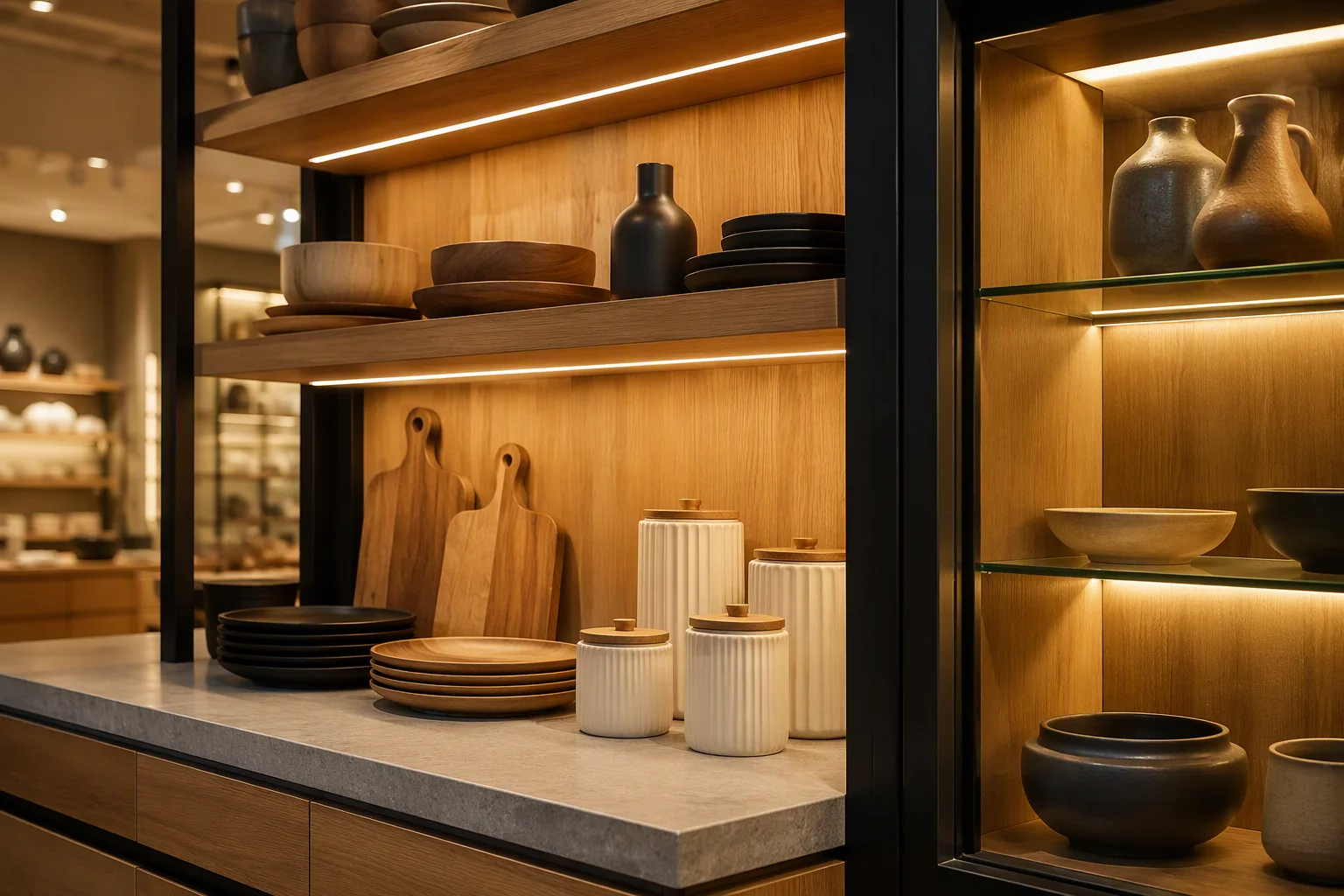
Retail shelving is one of the clearest uses for COB LED strips. A strip can be concealed under a shelf, inside a display cabinet, or along the rear edge of a merchandising bay. The goal is not simply to add light; it is to place a consistent layer of illumination where customers look at products, packaging, finishes, and price information.
The strip should be positioned so the shelf itself does not create a hard shadow across the merchandise. A diffuser or channel can protect the light line and help integrate it into the joinery. Before installation, test the chosen colour on the actual product packaging and shelf material. Glossy packaging, dark products, wood grain, and glass can all change the perceived result.
Specification focus: continuous appearance, shelf depth, glare control, colour consistency, cable routing, cleaning access, and replacement access.
2. Hotel reception desks and hospitality interiors
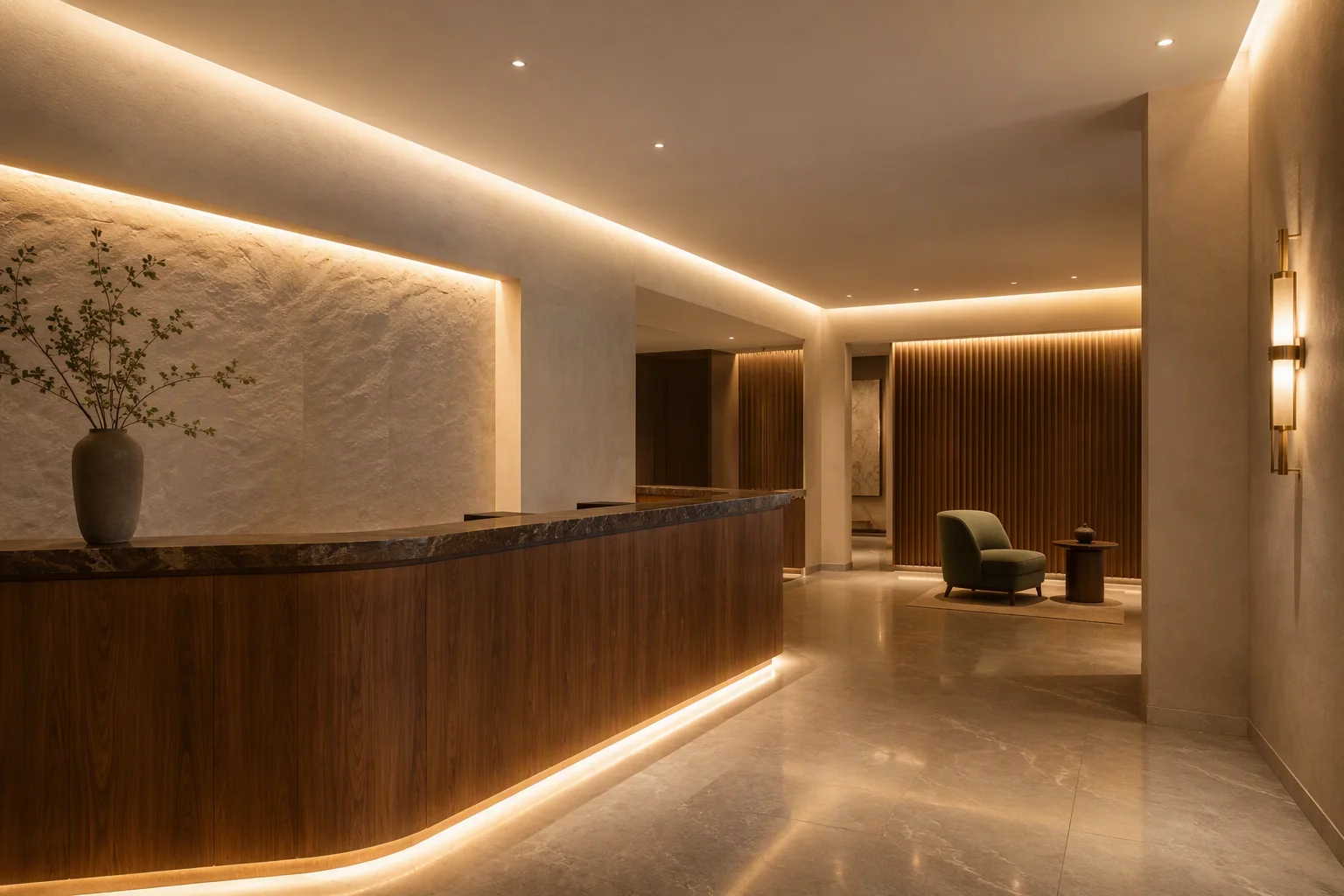
Hotels use layered light to create a sense of arrival and to help guests read the space. COB LED strips can be concealed under a reception counter, inside a wall feature, along a ceiling recess, or behind a decorative panel. Because the light line is visually smooth, it can support a calm architectural composition instead of drawing attention to individual points.
Hospitality projects often combine several lighting scenes: arrival, daytime operation, evening ambience, cleaning, and events. The COB strip should therefore be coordinated with the dimming or control system selected for the project. Confirm compatibility before procurement; do not assume that every strip and dimmer will perform correctly together.
Specification focus: scene control, continuous diffusion, material colour, guest-facing glare, cleaning schedule, service access, and coordination with the interior fit-out.
3. Offices, meeting rooms, and workplace millwork
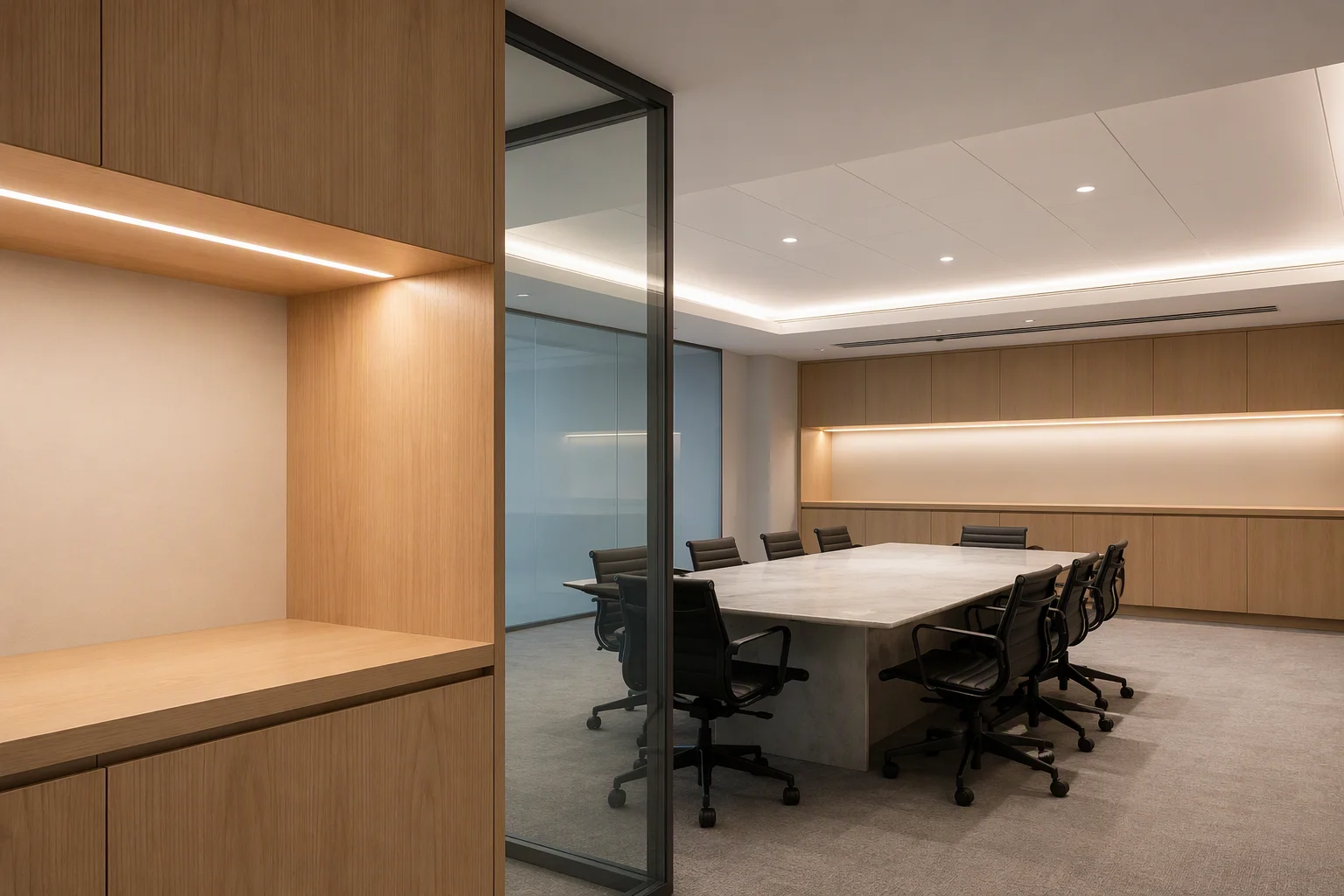
In offices, COB LED strips are often integrated into storage walls, reception joinery, meeting-room millwork, ceiling coves, and architectural partitions. They can provide a controlled ambient layer or a local accent that separates a work zone from a circulation zone. The light should complement the main workplace lighting rather than create visual competition or glare on screens and glass.
A commercial office specification should distinguish between decorative linear light and task lighting. A concealed COB strip in a cabinet or wall detail may not provide the same visual or ergonomic function as a designed task luminaire. Coordinate mounting height, viewing angle, colour requirement, dimming range, and the location of occupants before finalising the layout.
Specification focus: screen reflections, visual comfort, colour consistency across a long run, control zones, integration with ceiling systems, and access for facilities teams.
4. Restaurants, cafés, and food-service counters
Restaurants use linear light to reveal counter materials, shelving, wall textures, and the edge of a service area. COB LED strips can be concealed under a counter lip, inside open shelving, behind a decorative panel, or in a ceiling recess. The continuous line helps keep the visual language clean when the project uses stone, timber, stainless steel, or textured plaster.
Food-service spaces need practical detailing. Grease, steam, cleaning chemicals, heat, and frequent contact can affect the installation environment. Select the product and protection method for the actual location, keep electrical connections away from avoidable exposure, and coordinate cleaning access with the kitchen or facilities team. A decorative strip should not be specified as a substitute for a compliant work-area lighting system.
Specification focus: cleaning method, heat and moisture exposure, concealed cable routes, food-service coordination, glare on polished surfaces, and service access.
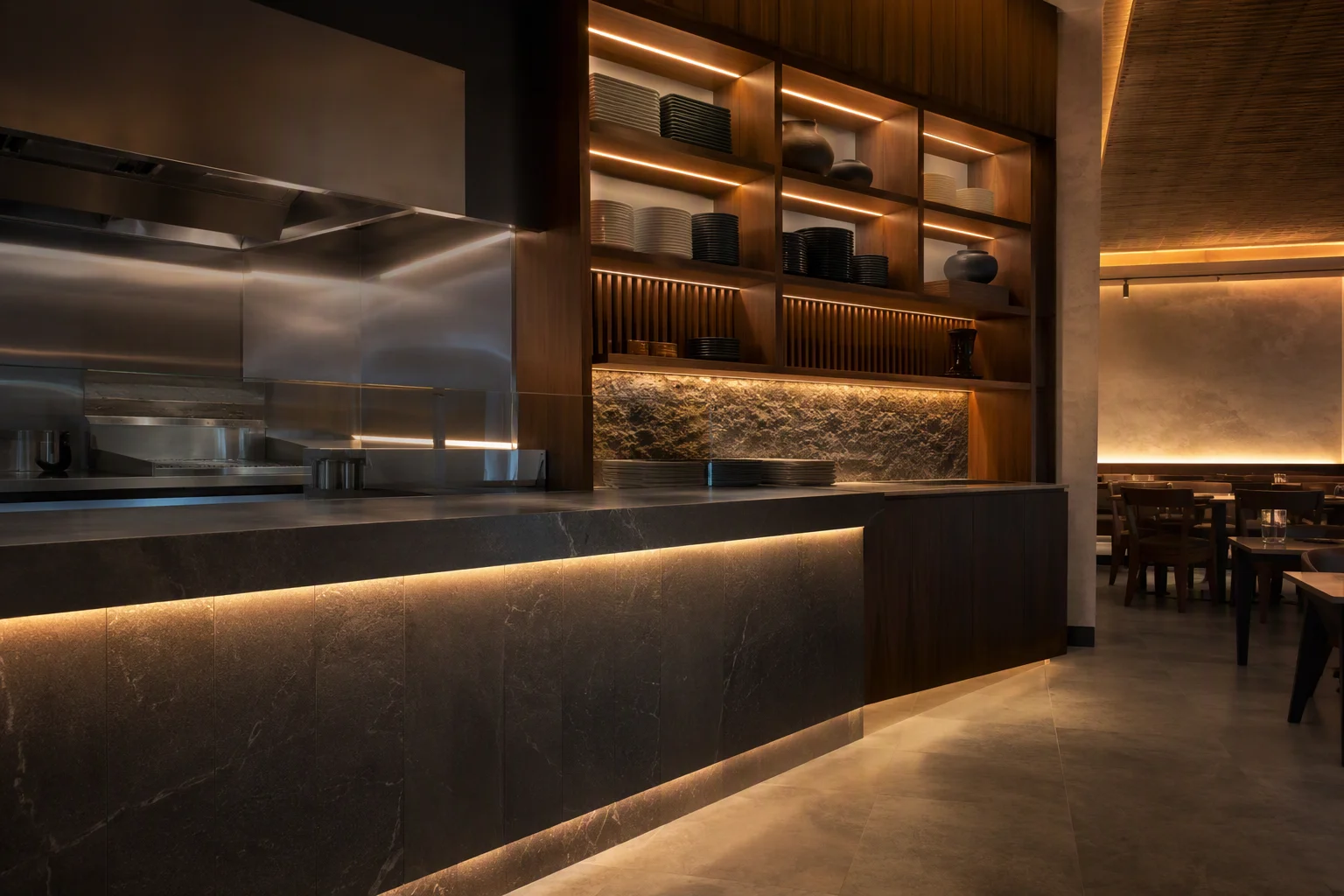
5. Kitchen cabinets and commercial furniture
Furniture manufacturers and interior contractors use COB LED strips to add a controlled light layer to cabinet undersides, display furniture, wall units, and built-in counters. The strip can be placed close to the edge or recessed into a channel depending on the required visual effect. In commercial furniture, the detail must survive handling, transport, installation, and future cleaning.
The key question is not only whether the strip fits the cabinet. It is whether the profile, cable exit, power supply, and replacement method have been designed into the furniture package. A removable panel or accessible service zone can prevent a small electrical fault from becoming a full joinery repair.
Specification focus: available channel depth, edge position, cable exit, heat path, modular replacement, furniture assembly sequence, and final cleaning.
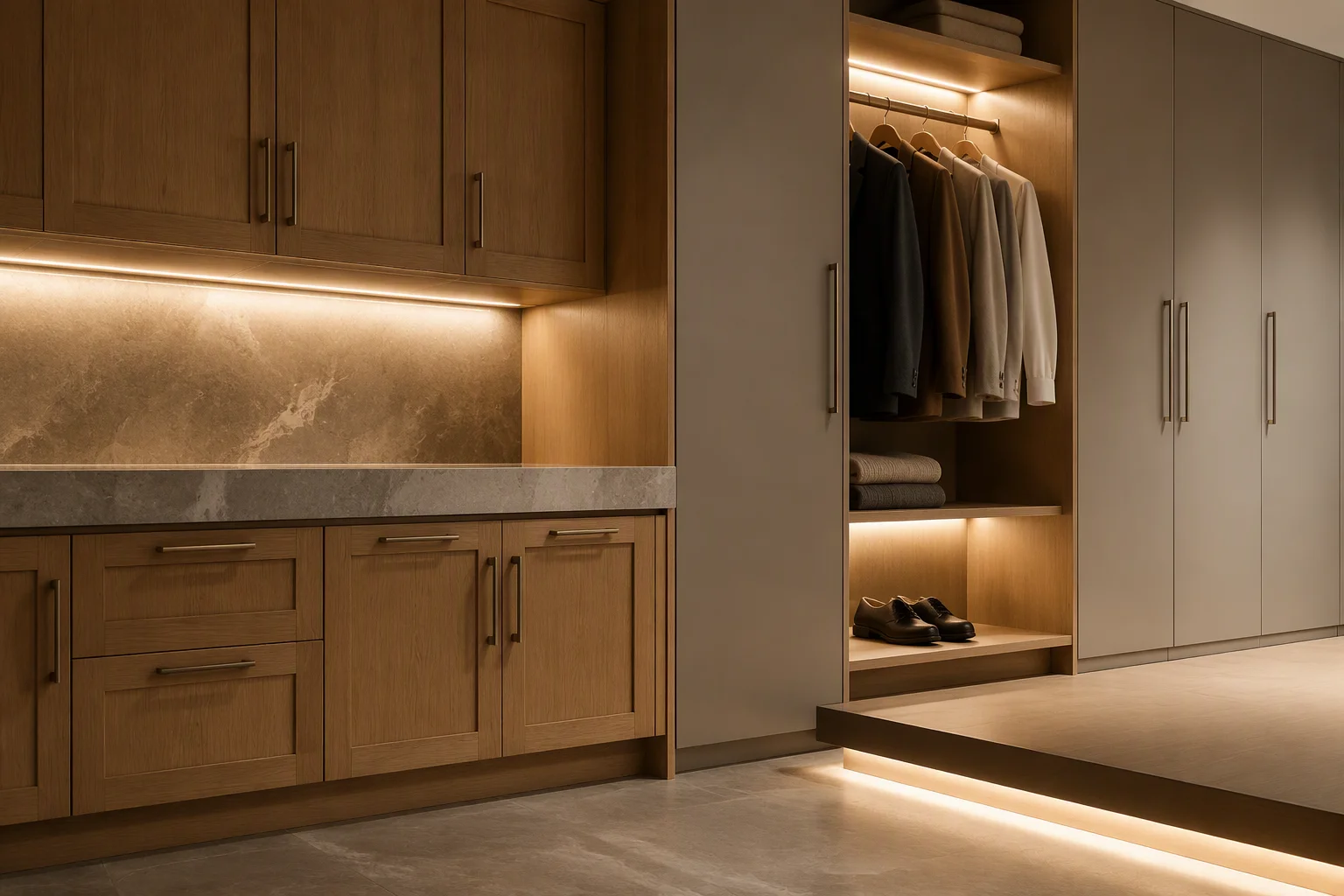
6. Wardrobes, dressing areas, and retail millwork
Wardrobes and dressing areas benefit from light that follows the edges of shelves, hanging zones, drawers, and vertical panels. COB LED strips can create an even line inside a wardrobe or illuminate the front edge of a commercial display system without exposing a regular pattern of LED points.
For clothing and material displays, colour selection deserves a physical sample review. Fabrics, leather, painted surfaces, and reflective hardware can appear different under different light. The strip should also be positioned to avoid creating a bright line directly in the occupant’s eye when a door or drawer is opened.
Specification focus: door and drawer movement, bend direction, profile depth, glare, colour evaluation, sensor or switch integration, and replaceable sections.
7. Display cases, museums, and premium showrooms
Display cases need controlled illumination that reveals the object without creating distracting points, hard shadows, or reflections in the glass. COB LED strips can be concealed along the top, side, or rear edge of a case, provided the mounting method and heat path are suitable for the case construction.
Case lighting should be tested with the actual glass, backing material, and object geometry. A light source that looks even on a blank sample may create a reflection or bright patch once the case is assembled. Keep drivers, connections, and maintenance access outside the sealed display volume where the design requires it, and coordinate the detail with the case fabricator.
Specification focus: reflection control, object distance, heat management, access for relamping or replacement, colour stability, and coordination with glass and case hardware.
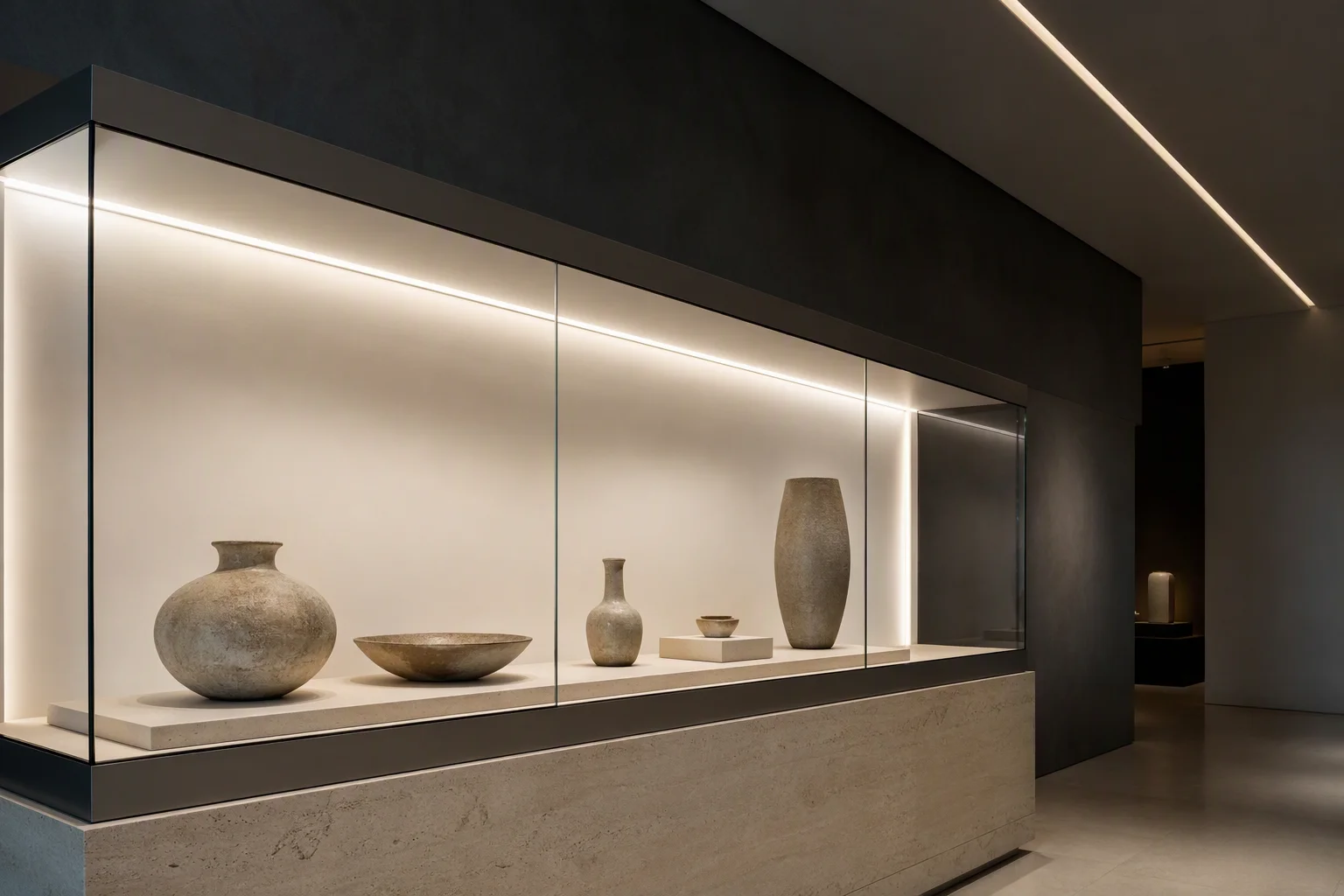
8. Architectural coves, ceiling recesses, and wall washes
COB LED strips are well suited to concealed architectural details where the viewer should see a smooth wash or line rather than the light source itself. Typical locations include ceiling coves, wall recesses, stair edges, niches, bulkhead details, and linear reveals. The result depends heavily on the distance from the surface and the reflectance of the surrounding material.
During mock-up, test the strip with the final paint, stone, timber, or plaster. A short sample can reveal whether the light is too close to the surface, whether the diffuser is visible, and whether joints or transitions will be noticeable. Long commercial runs also require a clear plan for voltage drop, feed points, and access.
Specification focus: throw distance, surface reflectance, profile integration, feed-point planning, dimming behaviour, thermal path, and transition details.
9. Reception, wayfinding, and branded environmental details
Commercial spaces often use light to help visitors understand where to enter, wait, move, or gather. COB LED strips can be concealed behind reception details, under a counter edge, along a handrail or wall reveal, and around a shaped environmental feature. In these locations, the strip is part of the spatial identity rather than a standalone sign.
Keep the visual hierarchy clear. If the line is used for wayfinding, it should support the route without competing with essential information or accessibility requirements. If it is used as a branded environmental feature, coordinate colour, brightness, switching scenes, and maintenance with the wider identity system. Avoid treating the light source as the only wayfinding device.
Specification focus: viewing distance, route clarity, brightness balance, control scenes, public-area durability, and coordination with signage and accessibility design.
10. Commercial signage and branded environments
COB LED strips can be used inside shallow letters, behind panels, around counters, and in custom branded environments where an even line of light is more important than a visible point source. The installation must be designed around the sign geometry, letter depth, diffuser, access panel, and power equipment.
For a signage project, request a physical sample or prototype section before approving production. A rendered logo does not show how joints, corners, cable exits, or access panels will look in the finished sign. Confirm whether the strip is the primary light source or only an accent around a separate sign face.
Specification focus: letter depth, diffuser distance, corner treatment, access panels, power supply location, service method, and night-time viewing distance.
Which Commercial Applications Benefit Most from COB Technology?
Application | Primary lighting task | Most important design check | Typical coordination partner |
|---|---|---|---|
Retail displays | Product and shelf illumination | Glare, shelf shadow, colour evaluation | Joinery and visual-merchandising teams |
Hotels and hospitality | Ambient layers and material accents | Scene control and guest-facing comfort | Interior designer and controls contractor |
Offices | Millwork and architectural accents | Screen reflection and task-light separation | Workplace designer and facilities team |
Restaurants | Counter, shelf, and architectural detail | Cleaning, heat, steam, and moisture exposure | Kitchen consultant and fit-out contractor |
Furniture and cabinets | Under-cabinet and built-in illumination | Assembly sequence and service access | Furniture manufacturer |
Wardrobes and millwork | Interior edge and hanging-zone light | Door movement, glare, and colour appearance | Joinery contractor |
Display cases | Even object illumination | Glass reflection and heat path | Case fabricator or curator |
Architectural coves | Continuous wall or ceiling wash | Throw distance and feed-point planning | Architect and electrical contractor |
Wayfinding details | Route and threshold emphasis | Brightness hierarchy and accessibility | Signage and environmental-graphics team |
Commercial signage | Even internal or edge illumination | Letter depth, diffuser, and maintenance | Sign fabricator |
How Do Installation and Heat Management Affect Performance?
COB LED strips still produce heat. The strip should be installed according to the selected product instructions, commonly with an appropriate aluminium channel or thermally useful mounting surface where required. A concealed location with no heat path can shorten service life or change light output over time.
Long runs need electrical planning. Confirm the feed direction, cable size, feed points, maximum run guidance, power-supply location, and access for testing. Do not assume that a single feed at one end will produce identical output across every commercial installation.
Connections deserve the same attention as the visible light line. End caps, solder joints, connectors, cable exits, and junction boxes must suit the environment and remain serviceable. In exposed or damp locations, the complete assembly—not only the strip body—determines whether the installation is appropriate.
How Should COB LED Strips Be Controlled?
Control requirements vary by project. A retail display may use scheduled scenes; a hotel may require several ambient presets; an office may connect the accent light to a room-control strategy; a cabinet may use a door or occupancy sensor. Select the control equipment only after confirming the strip's voltage, power demand, dimming compatibility, and the control protocol required by the project.
Do not add an unverified protocol to a product specification. Ask the supplier to confirm whether the exact SKU supports the intended control method, and test the complete combination of strip, power supply, dimmer, controller, and wiring before a large installation.
What Should Be Included in a Commercial COB LED Strip RFQ?
Project application and mounting location
Illuminated length and whether the run is continuous or divided into sections
Profile, emitting direction, bend direction, and available installation depth
Voltage, input power, feed-point plan, and power-supply location
Colour temperature, colour option, or tunable requirement
Dimming, sensor, scheduled-scene, or building-control requirement
Indoor, damp, dusty, or outdoor exposure conditions
Channel, diffuser, end treatment, connector, and cable-exit details
Required sample, mock-up, test report, warranty boundary, and replacement method
How Can Buyers Avoid Common Commercial Lighting Mistakes?
Choosing only from a product photograph
A photograph cannot show voltage drop, heat management, wiring, service access, or the actual colour response on the project material. Approve a sample or mock-up for critical applications.
Using a decorative strip as the only task light
A concealed accent line may support a space without providing the illuminance, glare control, or uniformity required for a work task. Coordinate decorative and functional lighting as separate layers.
Ignoring the mounting surface
The same strip can behave differently in an open aluminium profile, a tight cabinet recess, a plaster detail, or a sealed enclosure. Confirm the thermal and mechanical installation method before production.
Leaving the power supply inaccessible
Drivers, connectors, and junctions are service components. Provide access, identification, and enough space for inspection or replacement.
Assuming COB means every product is the same
COB describes the LED arrangement and visual character, not a complete project specification. Profile, emitting direction, voltage, power, colour, protection, control, and installation details still need to be confirmed for the selected SKU.
Frequently Asked Questions
What are the most common commercial uses for COB LED strips?
The most common uses include retail shelving, hotel and hospitality interiors, office millwork, restaurants, kitchen and commercial furniture, wardrobes, display cases, architectural coves, reception and wayfinding details, and commercial signage.
Why are COB LED strips useful for retail displays?
They can create a visually continuous line that illuminates shelves, cabinets, and product edges without making a regular pattern of LED points the main visual feature. The final result still depends on positioning, diffusion, colour choice, and glare control.
Can COB LED strips be used in hotels and restaurants?
Yes, when the selected product and installation method suit the environment. Hospitality and food-service projects should check cleaning, heat, moisture, control, cable routing, and service access rather than relying on the COB name alone.
Are COB LED strips suitable for office lighting?
They are suitable for many architectural, millwork, reception, and accent applications. They should not automatically be treated as a complete replacement for designed task or general workplace lighting.
Do COB LED strips need an aluminium profile?
The answer depends on the exact product and installation conditions. An aluminium profile can provide mechanical protection, diffusion, and a useful heat path, but the supplier's installation guidance should decide the required method.
Can COB LED strips be dimmed?
Some systems can be dimmed, but compatibility depends on the strip, power supply, dimmer, controller, and wiring. Confirm the complete combination with the supplier and test it before site-wide installation.
Are COB LED strips suitable for outdoor commercial projects?
Some products are designed for outdoor or damp applications, while others are intended for dry indoor locations. Confirm the exact product evidence and treat the strip, end caps, connectors, cable exits, power supply, enclosure, and installation workmanship as one system.
What is the best colour temperature for a shop or hotel?
There is no single best value for every project. Review the actual merchandise, timber, stone, fabric, food, and brand environment under sample lighting. The choice should also match the surrounding general lighting and the intended mood.