
Choosing between IP20, IP65 and IP67 LED strip comes down to two practical questions: where will the strip live, and what can actually reach it? For dry, climate-controlled interiors — cabinets, wardrobes, shelving and cove lighting in normal rooms — IP20 strip is the standard choice. For kitchens, bathrooms, laundries and covered outdoor details where the strip may see splashes, cleaning water or condensation, IP65 is generally the appropriate minimum. For exposed outdoor runs, wet zones and locations where water can pool or the strip may be temporarily immersed, IP67 is the rating to specify. The rating describes the component as tested, not your finished installation, so end caps, connectors, cable entries, profiles and site sealing decide whether the assembled system really performs at that level.
This guide explains how to read an IP code under IEC 60529, what the real differences between IP20, IP65 and IP67 are, which applications need each level, and how protection choices affect installation, thermal behaviour, dimming and warranty conversations.
Why IP Ratings Matter for LED Strip Installations
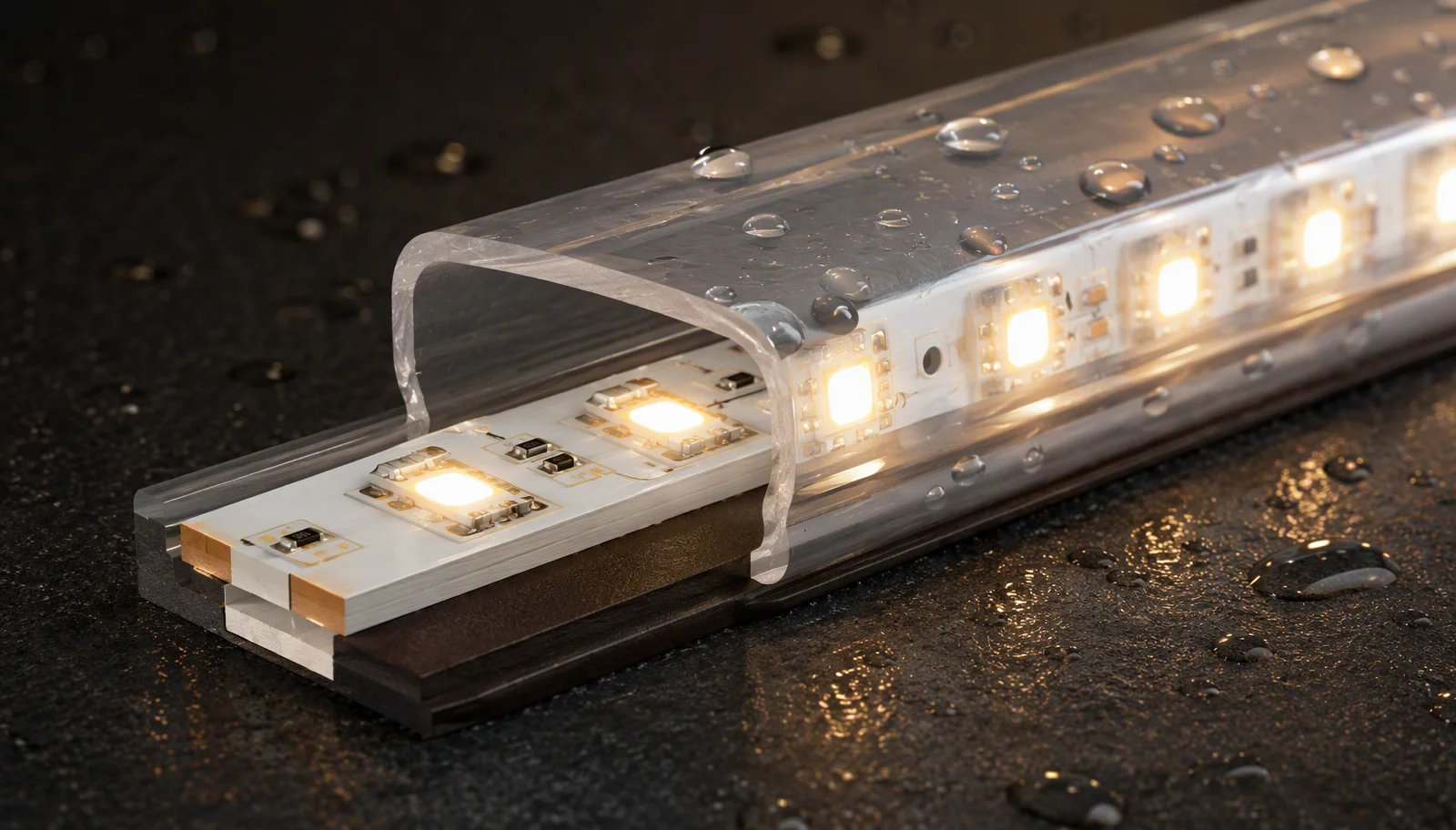
LED strip is a bare electrical assembly: LED chips, solder joints, copper tracks and connection pads carried on a flexible circuit board. In a dry, stable interior that architecture is perfectly reliable. Add moisture and it becomes a slow-acting problem. Condensation, splash water, cleaning residue and fine dust combine to corrode pads, bridge fine pitch solder joints and degrade the phosphor or encapsulant. The results are familiar to anyone who services lighting: flickering sections, colour shift along a run, dark patches, driver trips and eventually open circuits.
An IP rating is the industry shorthand for how well a component resists that environment. It matters for three reasons. First, safety and compliance: moisture in contact with energised low-voltage circuits is a risk that specifiers and contractors are expected to manage, and local installation rules usually treat wet locations differently from dry ones. Second, durability and cost of ownership: a strip specified one level too low may fail within a season, and every replacement is a service call-out in an occupied space. Third, commercial clarity: warranty terms, acceptance criteria and site sign-off usually refer back to the specified IP level, so an ambiguous specification tends to be settled by whoever has the least to lose.
It is equally important to understand what an IP rating does not mean. It is not a guarantee for the finished installation. It confirms that a particular item passed particular tests in a laboratory. Once you cut the strip, solder or plug in connectors, fit end caps, thread a cable through a wall and seal it on site, the assembly becomes a new construction with its own real-world protection level. Treat the IP rating of the strip as the starting point of the specification, not the conclusion.
How to Read an IP Rating: The Two Digits Explained
The IP code is defined internationally in IEC 60529. It is written as the letters IP followed by two digits. The first digit describes protection against solid foreign objects, including dust. The second digit describes protection against water. Where only one characteristic is verified, the unverified position is shown as an X. Additional letters can be added after the digits to describe extra protection — for example against access to hazardous parts — but for strip lighting the two digits do most of the work.
First digit: protection against solid objects and dust
The first digit runs from 0 to 6. A rating of 2 means solid objects larger than roughly a finger are excluded, which is why IP20 strip has no meaningful dust protection at all: particles and cooking grease can settle freely on the circuitry. A first digit of 5 means dust protected — a limited quantity may enter, but not enough to interfere with operation. A first digit of 6 means dust tight: no dust ingress under the specified test conditions.
Both IP65 and IP67 therefore start from dust-tight construction, while IP20 does not. In practice the dust digit matters more than buyers expect. Dust that settles on a strip in a dry interior is usually harmless; dust that settles on a strip in a humid, greasy or industrial environment holds moisture against the board and accelerates corrosion, which is why dust protection and water protection are usually specified together rather than separately.
Second digit: protection against water
The second digit runs from 0 to 9K and describes increasingly demanding water tests. Level 0 means no protection. Level 4 covers splashing water. Level 5 covers water projected as a jet. Level 6 covers powerful water jets. Level 7 covers temporary immersion under defined test conditions. Level 8 covers continuous immersion under conditions agreed between manufacturer and user.
Two consequences follow from that list. First, IP65 and IP67 protect against different kinds of water exposure. IP65 is tested against jets and is therefore well suited to washdown and splash-prone surfaces. IP67 is tested against temporary immersion and suits locations where water can collect around the strip. A higher second digit does not automatically imply better performance in every scenario, because the tests are different rather than simply more severe. Second, neither level implies indefinite underwater service: continuous immersion sits in level 8 territory. If a project involves permanent submersion, that is a different conversation with the supplier, different sealing and different expectations about lifetime.
IP20: Indoor, Dry-Location LED Strips
IP20 strip is the unprotected baseline. Its second digit is 0, so there is no water protection of any kind, and its first digit only keeps out objects larger than about a finger. Typical IP20 product is a flexible strip with exposed solder pads and cut marks, sometimes supplied with an adhesive backing. It is inexpensive, easy to cut and connect, and offers the widest choice of output, density and colour options because no coating or sleeve has to be applied over the light source.
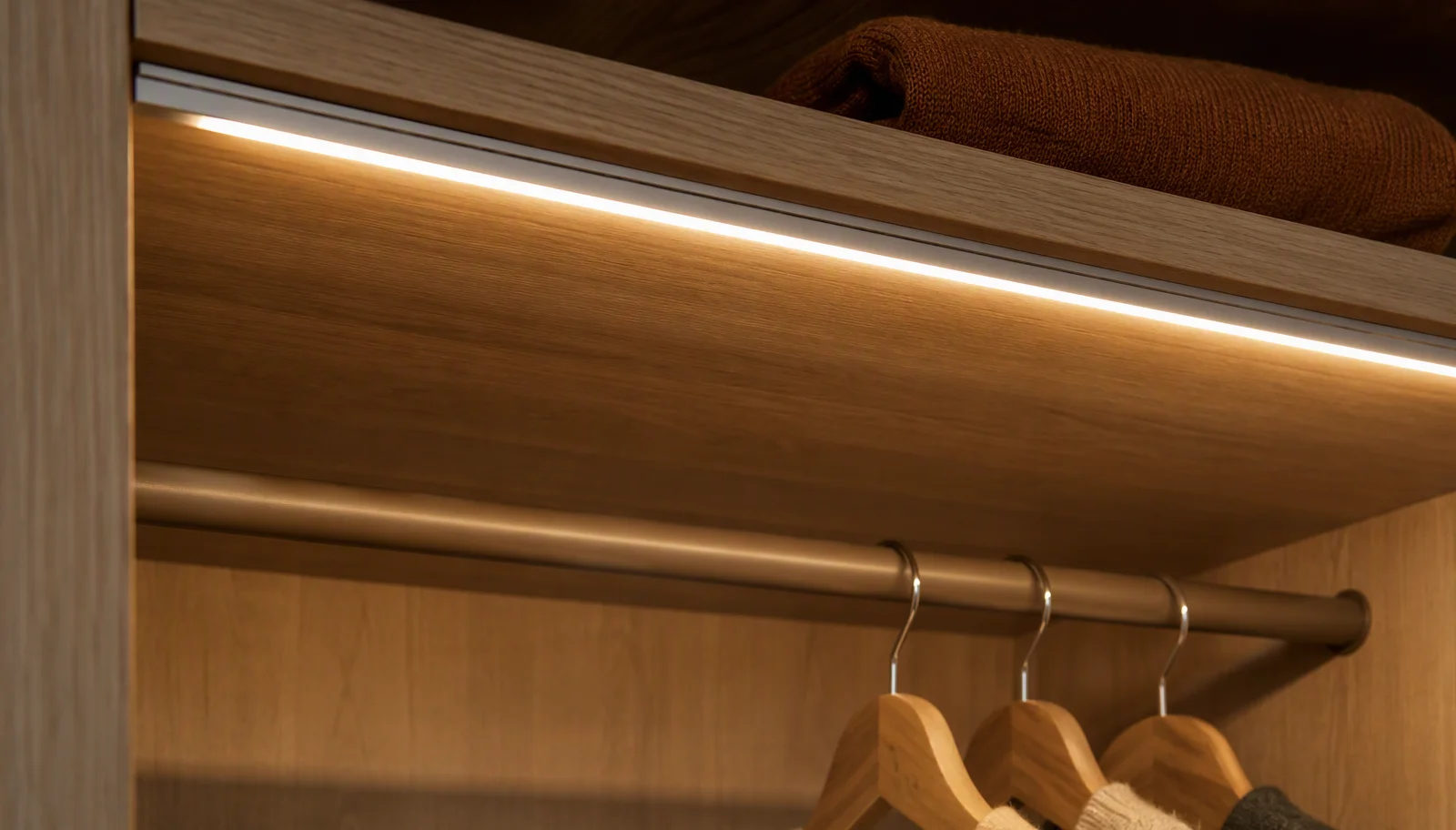
Its natural home is the dry interior. Wardrobes, drawer interiors, display cabinets, library shelving, cove details and ceiling coves in climate-controlled rooms all suit IP20. So do most residential and hospitality furniture applications, provided the strip sits away from the sink, the shower, the steam of a dishwasher door or the open window of an unheated room.
The practical cautions are simple. Keep IP20 strip out of splash and steam zones, and do not treat a nearby light switch or power point as evidence that water is unlikely to reach the strip. When cleaning, wipe surrounding surfaces with a damp cloth rather than spraying cleaner in the direction of the strip, and avoid wet mopping under open shelf runs. If a dry-location installation sits in a room with high humidity — an unventilated bathroom, a coastal property, a laundry — treat that as a wet-zone question and specify accordingly, because condensation follows temperature, not splashes.
IP65: Water-Resistant LED Strips
IP65 strip is dust tight and protected against water projected as a jet. That combination is what most suppliers mean when they describe a strip as water resistant. The protection is normally achieved by coating the strip with a conformal silicone layer, or by housing it inside a silicone sleeve or extruded profile, together with sealed terminations at each end of the run.
IP65 is not the same as waterproof, and it is not submersible. It is a good fit for surfaces that get wet and then drain: tiled splashbacks, under-cabinet runs near a sink, mirror lighting, covered outdoor ceilings and utility areas. It is not a fit for standing water, planters that fill with rain, pond edges or any location where the strip could sit under water for hours. It also does not protect against the spray from a high-pressure washer aimed directly at a joint, which is one of the most common causes of premature failure in kitchens and food preparation areas.
Where IP65 works best
Kitchen under-cabinet lighting close to a sink or dishwasher is a typical IP65 application, because the strip sees steam, splash and wipe-down cleaning. Bathroom mirror and vanity lighting usually calls for IP65 or better depending on the zone in which it is installed. Laundry and utility rooms, garages and workshops, commercial cold rooms with visible condensation, covered terraces and soffits, pergolas with a solid roof, and outdoor cabinetry that is sheltered from driving rain are all reasonable IP65 territory.
Two conditions usually decide whether IP65 performs in the field. The first is drainage: a profile that collects water will slowly fill, and the strip will fail from the ends inward, so profiles should be detailed so water can escape. The second is termination. A coated strip joined with bare solder and heat-shrink, or left with an open cut end, has an unprotected route into the circuit no matter what the specification sheet says. Specify IP-rated connectors, sealed end caps and cable glands as part of the same package as the strip.
IP67: Waterproof LED Strips for More Exposed Locations
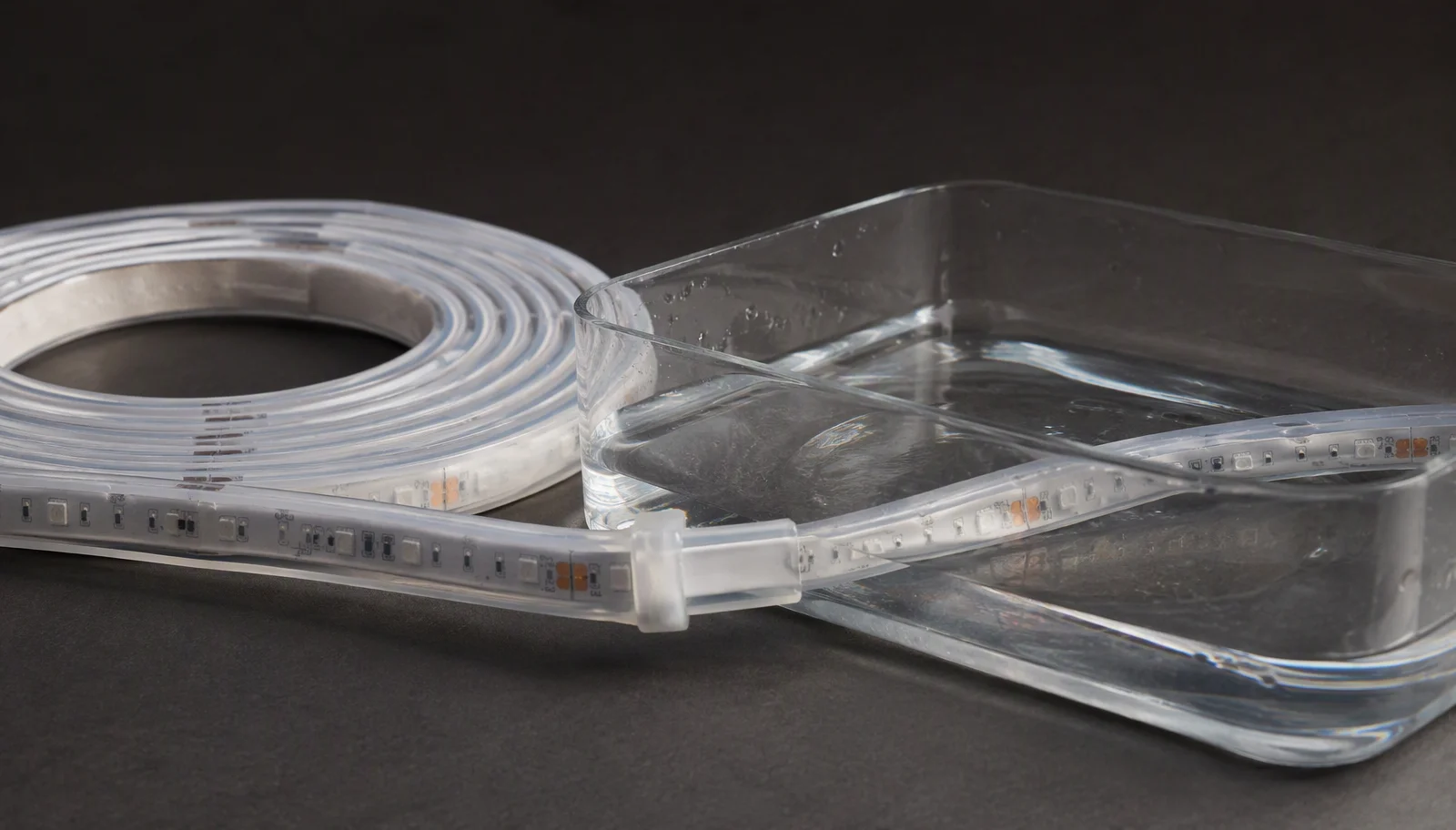
IP67 strip is dust tight and rated for temporary immersion under the defined test conditions of IEC 60529. This is the level that suppliers label waterproof, and it is the appropriate choice where water can collect around the strip, where the detail is fully exposed to weather, or where equipment is routinely washed down.
IP67 protection is normally achieved with fuller encapsulation: a thicker silicone extrusion around the strip, potting of the terminations, and dedicated sealed connectors and end caps that are supplied as a matched system. Because the encapsulant sits over the light source, encapsulation is a genuine design decision rather than a cosmetic one. It can influence light output, colour consistency and how easily heat escapes the assembly, and those effects depend on the material, thickness and construction used. The right question to ask a supplier is not simply "is it IP67?" but "which encapsulation, which connectors, and what happens to output and thermal behaviour compared with the unprotected version?"
It is also worth being precise about the limits. IP67 covers temporary immersion, not continuous immersion: a strip that spends its life underwater belongs in the level 8 discussion. And IP67 on the strip does not upgrade the rest of the system. The driver, the connection to the driver, the cable entry and any junction between runs each need their own protection, or they become the weakest point and define the real performance of the installation.
Where IP67 works best
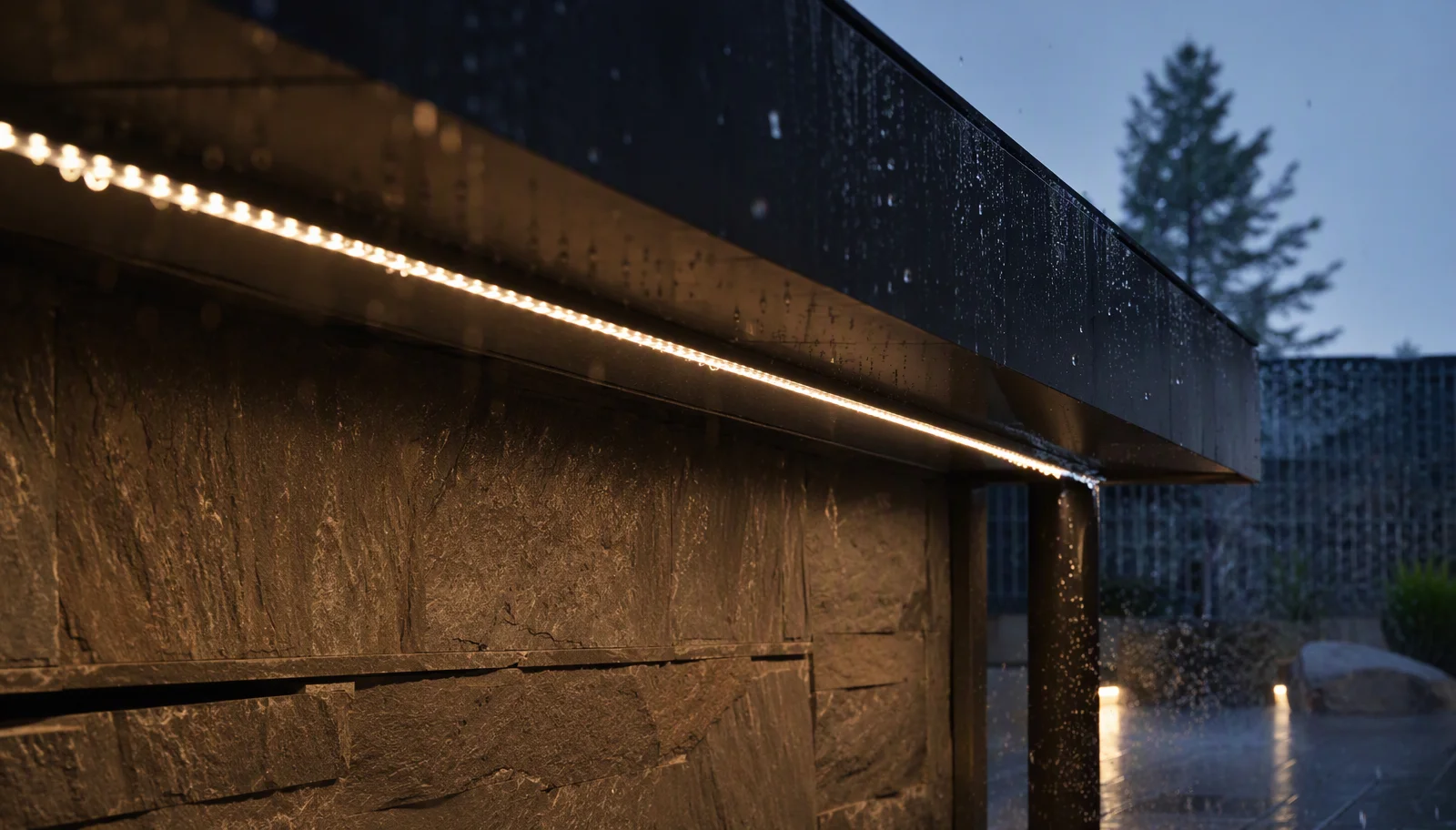
Exposed outdoor soffits, fascias and eaves; landscape and planter details where irrigation or rain collects; outdoor kitchens and bar counters; pontoons, boat interiors above the waterline and marine-adjacent structures; washdown areas in food production, cold stores and car care facilities; and generally any location where the strip is exposed to direct weather or to standing water after rain. IP67 is also a sensible upgrade in indoor wet zones where cleaning practice is aggressive, such as commercial kitchens and clinical areas, because it tolerates accidental immersion that IP65 does not.
The recurring caution with IP67 is that a higher rating invites less careful installation. Sealed connectors must be fully engaged, cable entries must be tight, and cut ends must be terminated with the manufacturer’s caps rather than left exposed. If a run must be cut on site, plan the cut so the remaining cut end is inside a sealed joint or cap, and never leave an unterminated end in a wet location.
IP20 vs IP65 vs IP67 at a Glance
The table below summarises how the three levels compare in the practical questions that come up during specification, procurement and installation. Treat it as a starting point for the conversation with a supplier rather than a substitute for the test evidence that should accompany the product.
Aspect | IP20 | IP65 | IP67 |
|---|---|---|---|
Ingress protection (IEC 60529) | Objects above roughly a finger; no water protection | Dust tight; protected against water jets | Dust tight; rated for temporary immersion |
Typical construction | Exposed PCB with bare solder pads | Silicone coating or sleeve, sealed ends | Fuller silicone encapsulation with matched sealed connectors and caps |
Where it belongs | Dry interiors: wardrobes, cabinets, shelving, coves in controlled rooms | Kitchens, bathrooms, laundries, covered outdoor soffits, damp zones | Exposed outdoor runs, washdown areas, wet zones, temporary immersion risk |
Submersion | Not suitable | Not suitable | Temporary immersion only; continuous immersion requires level 8 |
Connectors and cable entries | Standard connectors acceptable in dry locations | IP-rated connectors and sealed entries strongly advisable | Sealed connectors, potted joints and strain relief expected as standard practice |
Cleaning practice | Dry or lightly damp wiping; no sprays directed at the strip | Damp wiping; avoid high-pressure jets at joints | Damp wiping; still avoid pressure washing directly at connections |
Heat management | Simplest to cool in open air | Coating reduces airflow; check mounting surface and drive level | Highest attention needed; encapsulated assemblies should be mounted to a heat-sinking surface and drive level confirmed with the supplier |
Dimming considerations | Widest choice of drivers and dimmers | Confirm dimmer compatibility and keep the driver in a dry, accessible location | Same as IP65, plus verify that the driver and any control interfaces are protected too |
Relative cost and installation effort | Lowest | Moderate | Highest |
Main warranty exposure | Dry indoor conditions only | Damp and wet-zone conditions, provided accessories match | Exposed and immersed conditions, provided the whole assembly is sealed |
IP65 vs IP67: Which One Do You Actually Need?
In most projects the choice is not between good and better, it is between two different kinds of exposure. Work through these questions in order and the answer usually becomes obvious.
Is the strip ever covered by standing water or repeatedly washed down? If yes, IP65 is not sufficient and IP67 is the minimum. If water only splashes and drains away, IP65 is usually adequate.
Is the location fully exposed to weather? Open soffits, fascias and landscape details see wind-driven rain, leaf litter and cycles of wetting and drying. IP67 with a drainage-aware profile is the safer specification, even when the strip is technically under a roof line.
Is the exposure indoors but humid? Kitchens, bathrooms, laundries, cold rooms and coastal interiors produce condensation that behaves differently from splash. IP65 is the normal minimum, and IP67 is worth considering where cleaning is aggressive.
What is protecting the driver and the connections? IP rating applies to the strip, but the driver, dimmer and junctions are separate components with their own requirements. If they cannot be installed in a dry, accessible location, they need protection as well.
How will the installation be serviced? Sealed assemblies are not designed to be opened repeatedly. If a future change is likely, plan access and spare parts before sealing rather than after.
The honest summary is that IP67 is not a universal upgrade. In a dry interior it adds cost and thermal complexity for no practical benefit. In an exposed location it is cheap insurance. The expensive mistake is almost never choosing 67 where 65 would have done; it is choosing 20 or 65 where water actually reaches the strip.
How IP Rating Affects Installation, Dimming and Warranty
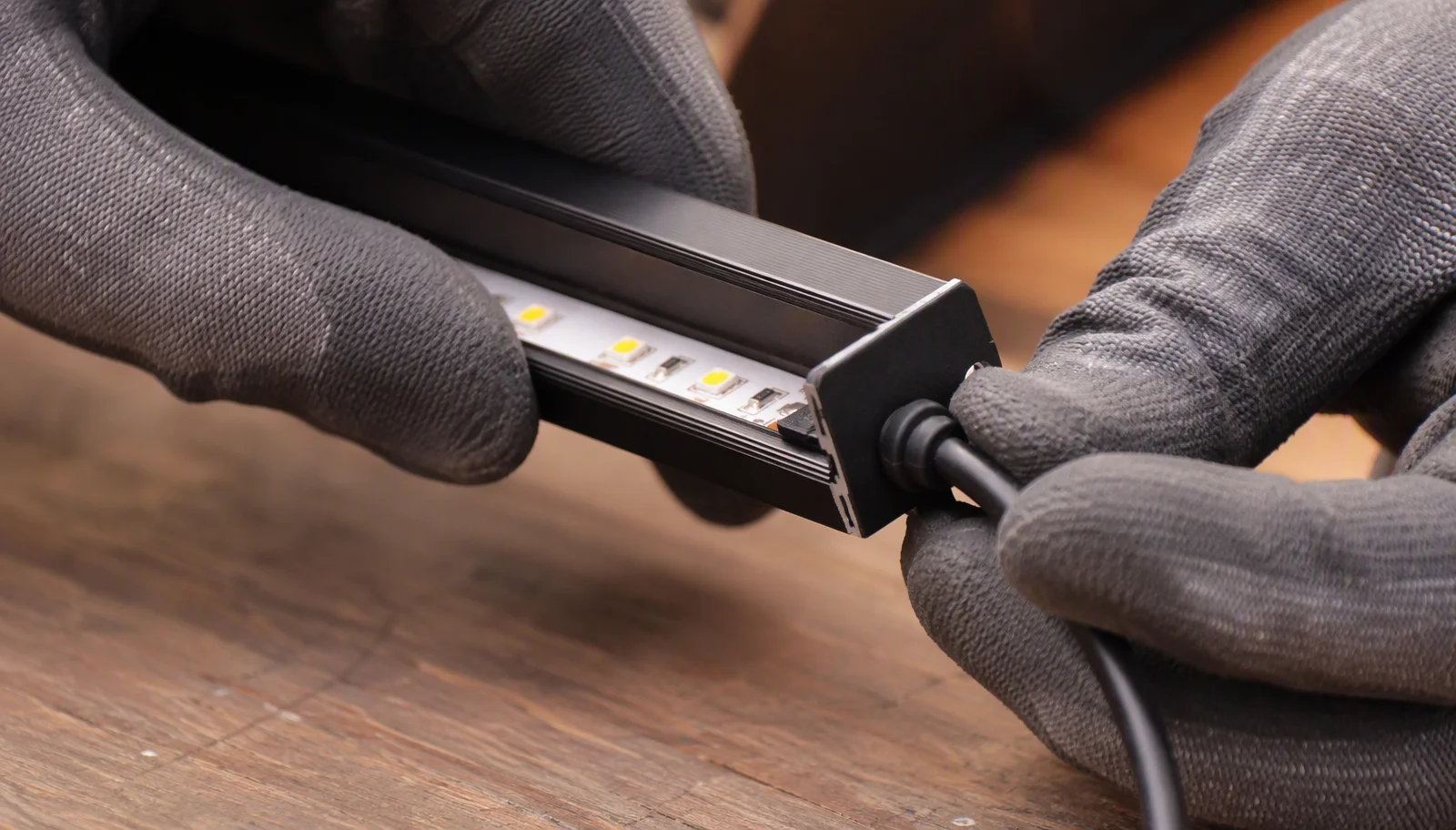
Installation. Protection has to survive the installation process. Cut ends must be terminated with sealed caps, connections should use the manufacturer’s IP-rated connectors rather than bare solder and adhesive-lined tubing, and cable entries should be made through glands or sealed knockouts rather than drilled holes. Sealed strip is less flexible than unprotected strip, so bends should respect the minimum radius the profile allows, and adhesive should not be the only fixing method in a wet location. Junctions should sit above the likely water line, and profiles should be detailed with drainage in mind rather than forming a trough that traps water.
Thermal behaviour. LEDs lose efficiency and life as junction temperature rises, and any coating or encapsulation changes how easily heat leaves the strip. A sealed strip mounted on a poorly conducting surface has a different thermal profile from an unprotected strip in free air. In many cases the practical answer is to mount onto a metallic profile that acts as a heat sink, to allow some ventilation where the design permits it, and to confirm the appropriate drive level with the supplier rather than assuming the same current is suitable for every variant. Thermal performance is also the reason a coated strip should not be pushed to the same output as its unprotected equivalent without checking.
Cleaning and maintenance. A higher rating widens the cleaning methods that are tolerable, but it does not make the assembly indestructible. Damp wiping with a neutral cleaner is safe practice for sealed strip. Solvent-based cleaners, abrasive pads and high-pressure jets directed at joints are best avoided, and cleaning crews should be told where the sealed joints are so that they are not treated as ordinary surfaces.
Dimming. The IP rating of a strip does not change which dimming technology works with it, but it does change where the rest of the dimming system can live. Drivers, receivers and control interfaces are generally not IP rated to the same level as the strip, so they should either be located in a dry, accessible enclosure or be specified as protected versions. Dimming and control cables, and the junctions where they meet the strip, need the same attention as the power feed: a well-sealed strip connected to an unprotected dimmer is still an unprotected circuit. Where a project uses a sealed strip in an exposed location, confirm dimmer compatibility with the supplier as part of the order, and plan access for future servicing.
Warranty and acceptance. Warranty terms for LED strip commonly assume the product was installed in the environment it was specified for, with the accessories and terminations the supplier expects. An IP20 strip installed outdoors, an unsealed cut end, or a non-rated connector in a wet zone are typical grounds on which a claim can be declined, so the details are worth getting right at the order stage. For the buyer’s side of the same argument, keep installation photographs, batch or serial references, and the accessory list, and ask the supplier to confirm in writing which components the warranty covers. When specifying, also ask what test evidence accompanies the IP claim, whether the claim covers the strip alone or the strip with its connectors and caps, and whether the accessories carry the same rating.
Common IP Rating Mistakes to Avoid
Treating IP65 as waterproof. IP65 resists jets; it does not tolerate immersion. Standing water and repeated washdown are IP67 territory.
Assuming the strip rating covers the system. Connectors, end caps, cable entries and junctions are where most wet-location failures begin. Protect the whole assembly, not just the strip.
Using IP20 in a splash or steam zone. A dry-location strip under a sink, beside a shower or in an unventilated laundry is a warranty claim waiting to happen.
Cutting a sealed strip and leaving the cut end bare. Every cut end needs a sealed termination, and the cut should be planned so it ends inside a cap or connection rather than in the open.
Mixing ratings in one circuit. A sealed run joined with unsealed connectors gives the assembly the protection of its weakest link.
Forgetting the driver and control gear. Power supplies and dimming receivers have their own ingress requirements and need a suitable location or enclosure.
Rewriting the rules with cleaning. High-pressure washers and aggressive chemicals are common causes of damage even to IP67 assemblies, particularly at joints.
Ignoring the thermal consequence of encapsulation. Covered strip loses more heat slowly. Confirm mounting, drive level and expected lifetime for the sealed variant, not for the catalogue headline figure.
Ordering by label rather than by test evidence. Ask which IP test level was actually performed, on which configuration, and by whom.
IP Rating and Compliance: IEC 60529, CE and RoHS
The IP code is defined by IEC 60529, which sets out both the meaning of each digit and the test methods used to verify it. That is the reference to quote in a specification, because it tells a supplier exactly what evidence is being asked for: a test report, referencing IEC 60529, stating the specific levels achieved, and describing the configuration that was tested.
CE marking and RoHS documentation are frequently attached to LED strip datasheets, and they are often read as if they confirmed ingress protection. They do not. CE marking indicates that the manufacturer takes responsibility for conformity with the applicable European legislation for the product — electrical safety, electromagnetic compatibility and similar requirements depending on the product. RoHS concerns restrictions on certain hazardous substances in electrical and electronic equipment. Neither is an ingress protection test, and neither tells you whether a strip survived a water jet or an immersion test. A datasheet is stronger when it carries all three, but they answer different questions, and a compliance folder with CE and RoHS documents but no IEC 60529 test evidence is incomplete for a wet or exposed application.
One further point of precision: an IP rating applies to the item that was tested. If a strip was tested as IP67 but the connectors, end caps or glands in the shipment were not part of that test or are not rated to the same level, the assembled system has no claim to IP67. This is why the specification should say what the rating applies to, and why acceptance testing should look at a finished, sealed sample rather than at a bare reel.
Frequently Asked Questions
What does IP65 mean on an LED strip?
Under IEC 60529, IP65 means the strip is dust tight and protected against water projected as a jet. It is suitable for damp and splash-prone locations that drain freely, such as under-cabinet kitchen lighting, bathroom zones outside direct water contact, laundry areas and covered outdoor details. It does not mean the strip can be submerged or exposed to standing water.
Is IP65 the same as waterproof?
No. IP65 is best described as water resistant. It is tested against jets of water, not against immersion. Products marketed as waterproof are usually IP67, which is rated for temporary immersion, or IP68 for continuous immersion under agreed conditions. Using the two terms interchangeably is one of the most common causes of premature failure in kitchens and outdoor projects.
What is the difference between IP65 and IP67?
Both are dust tight, so the difference lies in the second digit. IP65 covers water jets; IP67 covers temporary immersion under defined test conditions. In practical terms, IP65 suits surfaces that get wet and then drain, while IP67 suits locations where water can collect around the strip or where the installation is routinely washed down. They are different tests rather than a simple good-better sequence.
Can I use IP20 LED strips in a bathroom?
Generally no, unless the strip is genuinely outside any splash, steam or condensation zone and the installation rules for the location allow it. Bathrooms combine humidity, cleaning water and temperature swings, all of which work against an unprotected strip. In practice IP65 is the usual minimum for bathroom lighting, with IP67 considered where cleaning is aggressive or water contact is likely. Where local regulations define bathroom zones, those rules take precedence over any general recommendation.
What IP rating do I need for outdoor LED strips?
For covered outdoor locations that stay dry apart from humidity, IP65 is often enough. For exposed locations — soffits, fascias, pergolas with open sides, planters and landscape details where rain collects — IP67 is the safer specification. Whatever the rating, the connectors, end caps, cable entries and driver must be protected to the same standard, and profiles should be detailed so water drains away instead of collecting.
Is IP67 suitable for permanent outdoor installation?
IP67 can be suitable for many exposed outdoor installations, because it is dust tight and rated for temporary immersion. It is not intended for locations where the strip remains underwater. Permanent submersion, such as in a fountain or pond, falls into the level 8 category and requires a different product, a different sealing method and an explicit conversation with the supplier about lifetime expectations.
Do IP65 and IP67 strips need special connectors?
Yes. A sealed strip joined with bare solder, open cut ends or unrated connectors loses much of the benefit of its rating, because the joints become the path for water ingress. IP-rated connectors, sealed end caps and strain relief are normally part of a properly specified system. It is worth confirming at the order stage whether the connectors and caps carry the same IP rating as the strip, and whether they were included in the test evidence.
Does a higher IP rating reduce brightness or CRI?
Encapsulation changes the optical path, so it can affect measured output, colour consistency and appearance compared with an unprotected strip of similar specification. The size of the effect depends on the material, thickness and construction used, so it should be confirmed against the supplier’s data for the specific sealed variant rather than assumed from the unprotected version. Encapsulation also changes thermal behaviour, which affects how hard the strip can reasonably be driven.
What is IP68 and do I need it?
IP68 covers continuous immersion under conditions agreed between the manufacturer and the user. It is used for fountains, ponds, underwater architectural features and some industrial washdown equipment. Most cabinet, cove, facade and soffit projects do not need it: IP67 is sufficient for temporary immersion, and specifying IP68 where it is not required usually adds cost and constrains design for no practical gain.
How is an IP rating tested and certified?
Ingress protection is verified by testing to IEC 60529: solid-object and dust tests for the first digit, and water tests — spray, jet, immersion — for the second. The result applies to the tested configuration, which should be described in the report. When assessing a supplier, ask for the test report rather than a logo, check which levels were actually tested, confirm whether connectors and end caps were part of the tested item, and keep the document with the project file as evidence for warranty and acceptance discussions.
Choosing the Right IP Rating for Your Next LED Strip Order
The short version: match the rating to the real environment, then protect the whole assembly rather than the strip alone. Dry indoor furniture and cabinet lighting sits comfortably at IP20. Kitchens, bathrooms, laundries and covered outdoor details generally start at IP65. Exposed, washdown or water-collecting locations call for IP67, while permanent submersion is a level 8 conversation. In every case, specify the connectors, end caps, cable entries and driver location as part of the same decision, and ask for IEC 60529 test evidence that describes exactly what was tested.
If you are specifying LED strip for furniture, cabinetry, hospitality or an outdoor detail, our team can help you match IP level, sealing method, profile and dimming arrangement to the application, and flag the points where installation practice will decide whether the rating holds up in service. Share your drawings, locations and cleaning regime and we will recommend a configuration you can specify with confidence.
Sources and References
IEC — IP ratings: https://www.iec.ch/ip-ratingsChoosing between IP20, IP65 and IP67 LED strip comes down to two practical questions: where will the strip live, and what can actually reach it? For dry, climate-controlled interiors — cabinets, wardrobes, shelving and cove lighting in normal rooms — IP20 strip is the standard choice. For kitchens, bathrooms, laundries and covered outdoor details where the strip may see splashes, cleaning water or condensation, IP65 is generally the appropriate minimum. For exposed outdoor runs, wet zones and locations where water can pool or the strip may be temporarily immersed, IP67 is the rating to specify. The rating describes the component as tested, not your finished installation, so end caps, connectors, cable entries, profiles and site sealing decide whether the assembled system really performs at that level.